
Home › Forums › DTF Printer Hub › The Real Power of DTF Hat Printing in a Custom Economy
Tagged: DTF Hat Printing
- This topic is empty.
-
AuthorPosts
-
31 March 2026 at 8:04 pm #1042
Dowinsss
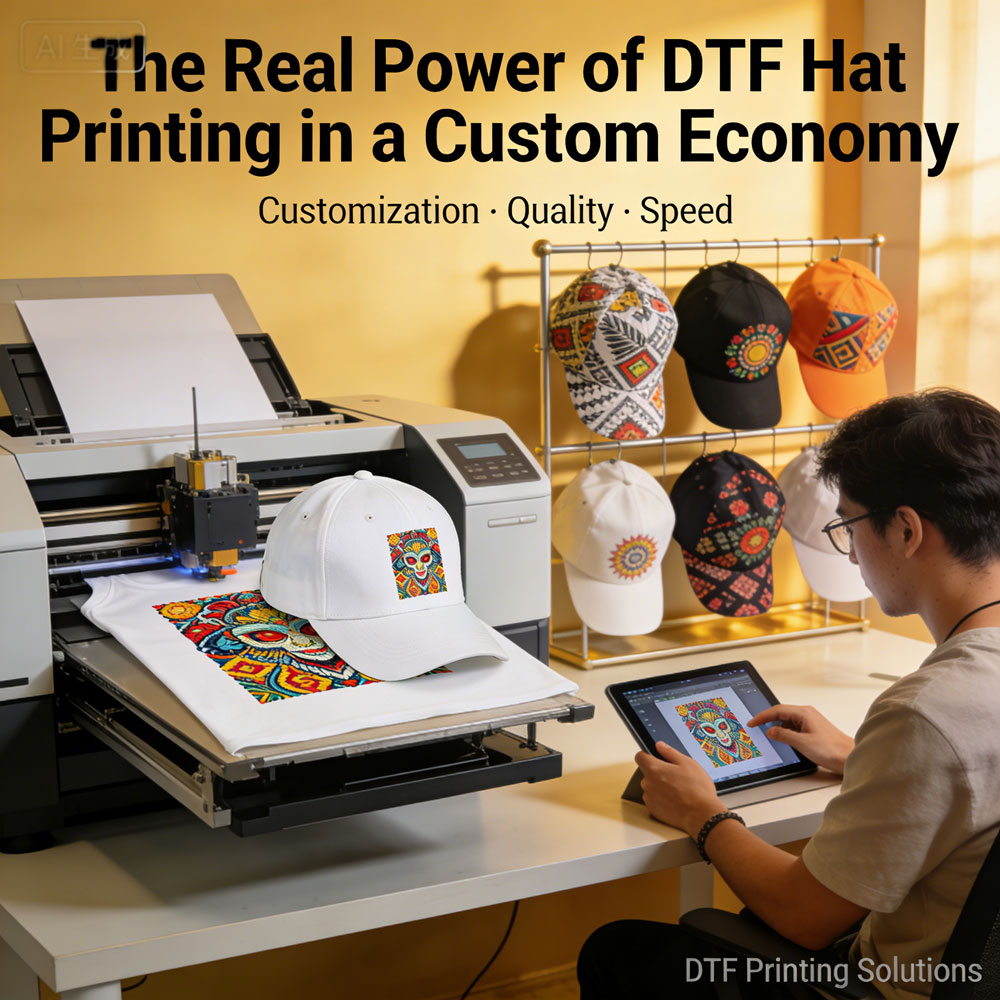
KeymasterIn the era of on-demand manufacturing, customization is no longer a niche—it is the default expectation. Among all apparel categories, hats represent one of the most technically challenging surfaces: curved, structured, and often made from diverse materials. Traditional printing methods struggle here. Direct-to-Film (DTF) printing doesn’t.
But the real story is not the process itself—it’s how DTF is quietly reshaping the economics and logic of small-batch production.
What DTF Printing Really Changes
DTF (Direct-to-Film) printing reverses the traditional workflow. Instead of printing directly onto fabric, designs are first printed onto a transfer film and then heat-pressed onto the final product.
This separation is critical.
It allows:
- Batch production of transfers
- Flexible application across multiple products
- Decoupling of printing from final assembly
For hats—where positioning, curvature, and pressure consistency matter—this is a breakthrough.
Why Hats Are a Different Battlefield
Printing on hats is not the same as printing on flat garments.
Challenges include:
- Curved surfaces that distort designs
- Uneven pressure during heat transfer
- Material diversity (cotton, polyester, nylon, treated leather)
DTF addresses these by shifting complexity away from the hat itself and into a controlled pre-transfer process.
Insight: The innovation is not better printing—it is relocating where precision happens.
The DTF Hat Process: A Controlled Workflow
The production process follows a structured sequence that ensures consistency and scalability:
1. Digital Design Preparation
High-resolution artwork is created and optimized for print, often including a white ink layer to enhance color vibrancy on dark fabrics.
2. Film Printing
The design is printed onto PET film:
- First color (CMYK)
- Then a white ink layer for opacity and contrast
3. Adhesive Powder Application
Hot-melt powder is applied to the wet ink, forming the bonding layer that will later adhere to the fabric.
4. Curing (Thermal Activation)
The film is heated (typically around 110–150°C) to melt and stabilize the adhesive layer.
5. Heat Transfer to the Hat
Using a cap heat press:
- Temperature ~120–160°C
- Pressing time ~10–15 seconds
The design is transferred and bonded to the hat surface.
6. Cooling and Peeling
After cooling, the film is removed, leaving a durable, high-definition print.
Data Insight: Why DTF Is Exploding Globally
Industry-wide adoption of DTF is accelerating due to three structural advantages:
1. Material Versatility
DTF works across cotton, polyester, blends, and even coated materials—critical for hats made from mixed fabrics.
2. No Minimum Order Constraint
Unlike screen printing, DTF is economically viable for single units and short runs.
3. Workflow Decoupling
Printing and pressing can be separated in time and location:
- Print today
- Transfer tomorrow
- Or outsource one stage entirely
This flexibility is redefining supply chains for small and medium businesses.
Breaking the Illusion: DTF Is Not “Easy”
Most marketing claims say DTF is simple. That is only partially true.
Real-world production reveals:
- Adhesion issues if temperature/pressure are inconsistent
- Print defects if curing is uneven
- Equipment maintenance challenges (e.g., nozzle stability)
These are not flaws—they are signs that DTF is a system, not a shortcut.
From industry discussions:
Adhesion failures often come down to “pressure, temperature, or curing.”
Conclusion: Mastery of process discipline—not machine ownership—is the real barrier to entry.
The Hidden Advantage: Scaling Without Scaling
DTF’s biggest disruption is economic, not technical.
Traditional model:
- Invest in tooling
- Produce large volumes
- Hope for demand
DTF model:
- Produce on demand
- Customize per order
- Scale without inventory
Even small operators can now:
- Serve niche markets
- Personalize products
- Compete with larger factories
This is not just efficiency—it is democratization of production.
Where the Industry Is Heading
DTF hat printing is evolving toward:
- Automated powder application and curing systems
- Integration with e-commerce and print-on-demand platforms
- Hybrid production models (outsourced transfers + in-house pressing)
The bottleneck is shifting:
- From printing speed → to workflow coordination
- From equipment → to data and order management
Final Perspective: Hats Are Just the Beginning
DTF printing for hats may look like a niche application, but it represents a deeper shift:
From:
- Fixed production lines
- Standardized outputs
To:
- Flexible systems
- Personalized manufacturing
Hats are simply the proving ground.
The real revolution is this:
Manufacturing is no longer about producing more.
It is about producing exactly what is needed—at the exact moment it is needed.DTF didn’t just improve printing.
It changed the rules. -
AuthorPosts
- You must be logged in to reply to this topic.