
Home › Forums › DTF Printer Hub › DTF Powder Storage: The Hidden Variable That Decides Print Quality
- This topic is empty.
-
AuthorPosts
-
10 April 2026 at 5:18 pm #1069
Dowinsss
Keymaster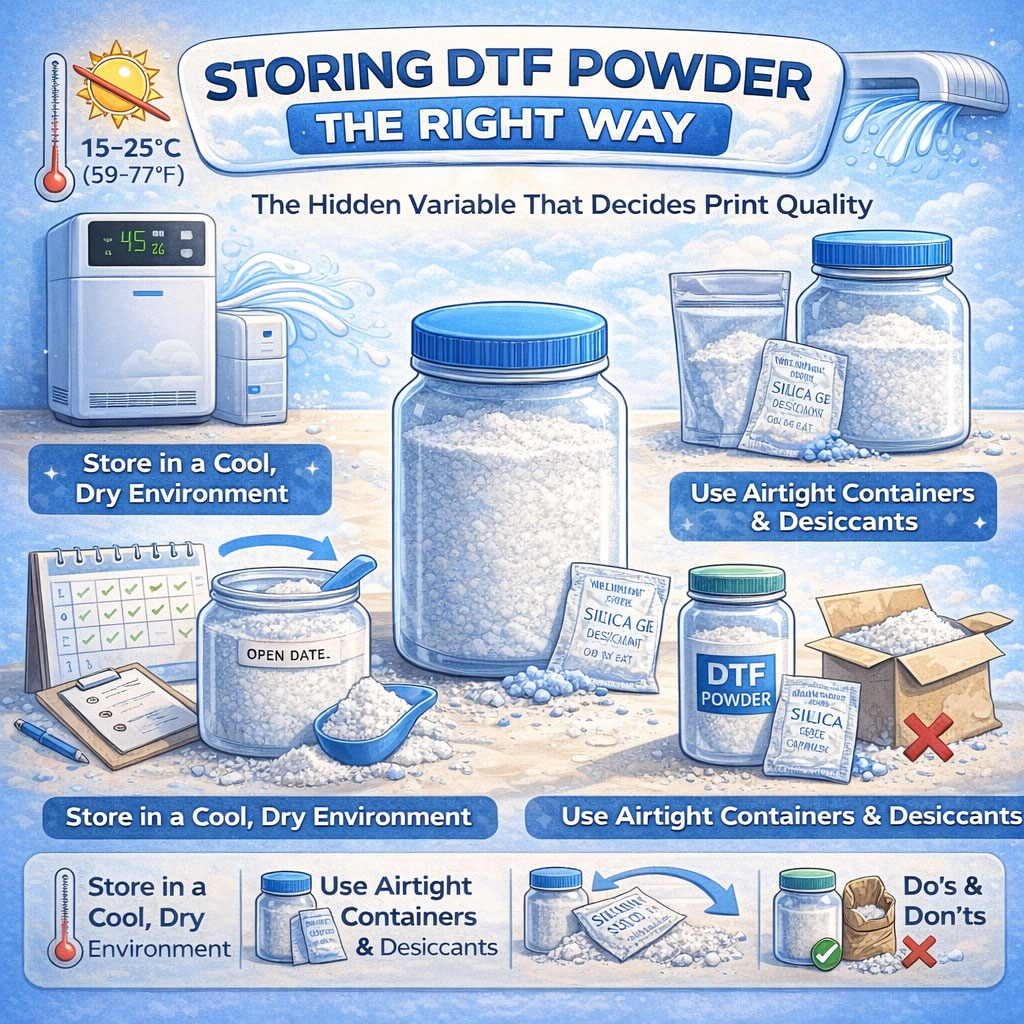
1. The Most Overlooked Factor in DTF Printing
In the DTF workflow, most attention goes to printers, inks, and RIP software. But data across print shops shows a different reality:
A significant percentage of print defects are not caused by machines—but by material degradation, especially DTF powder.
DTF powder is a polyurethane-based adhesive with one critical weakness:
it reacts aggressively to its environment.When improperly stored, it absorbs moisture, oxidizes, and loses bonding strength—leading to:
- Weak adhesion
- Uneven coating
- Color inconsistency
- Increased waste and reprints
Storage is not logistics. It is process control.
2. The Core Principle: Control the Environment, Control the Output
All effective storage strategies converge on one idea:
DTF powder must live in a stable microclimate.Industry data consistently points to the same thresholds:
- Temperature: 15–25°C (59–77°F)
- Humidity: below 50% RH
- No direct light exposure
Why? Because DTF powder is hygroscopic—it absorbs moisture from the air, which leads to clumping and performance loss.
This leads to a non-obvious conclusion:
DTF powder doesn’t “go bad” randomly—it degrades predictably based on environmental instability.
3. The Four High-Impact Storage Strategies (Reconstructed)
3.1 Build a Controlled Storage Environment
The first and most critical layer is the environment itself.
- Keep powder in cool, dry, and ventilated spaces
- Avoid proximity to heat presses, dryers, or sunlight
- Use hygrometers and dehumidifiers for real-time control
Advanced insight:
In high-volume print shops, microclimates form around machines. Even if the room reads 45% humidity, local zones may exceed safe thresholds.
3.2 Use Truly Airtight, Moisture-Proof Containers
Container choice is not trivial—it directly impacts shelf life.
Recommended options:
- Sealed plastic drums (HDPE/PP with silicone seals)
- Vacuum-sealed mylar bags for long-term storage
- Glass or food-grade containers with tight lids
Avoid:
- Cardboard or paper packaging
- Unlined metal containers (risk of contamination and static)
Key idea:
Air exposure = moisture + oxidation = performance loss.
3.3 Add Desiccants: Small Detail, Massive Impact
Silica gel or desiccant packs act as micro-environment stabilizers.
- Absorb residual moisture inside containers
- Extend usable life significantly
- Require regular replacement for effectiveness
Contrarian view:
Desiccants are not optional accessories—they are core components of storage systems.
3.4 Implement Rotation and Handling Discipline
Even perfectly stored powder degrades over time.
Best practices:
- Label purchase and opening dates
- Follow FIFO (First-In, First-Out) usage
- Minimize exposure time during use
- Use clean, dry tools only
Shelf life insights:
- Unopened: ~12–18 months
- Opened: ~6–9 months (optimal performance window)
Operational insight:
Most quality issues come from opened, poorly managed powder—not new stock.
4. What Actually Destroys DTF Powder (Beyond the Obvious)
Most guides stop at “heat and humidity.” That’s incomplete.
Hidden destroyers:
- Temperature fluctuations → repeated expansion/contraction
- Air exposure cycles → gradual oxidation
- Contamination (dust, oil, old powder) → bonding defects
- Improper handling → micro-moisture introduction
Even small deviations can compound over time.
5. The Economics: Storage vs Waste
Let’s reframe this in business terms:
Factor Poor Storage Optimized Storage Powder lifespan Shortened Maximized Print defects High Low Reprint cost Frequent Minimal Operational stability Inconsistent Predictable A small investment in storage (containers + humidity control) can reduce material waste dramatically.
6. A More Radical Perspective: Storage Is Part of Production
The industry treats storage as a passive step.
That’s outdated thinking.
In reality:
- Storage determines material behavior
- Material behavior determines print quality
- Print quality determines profitability
Therefore, storage is not a backend function—it is a front-end production variable.
Forward-looking print shops are already doing this:
- Dedicated climate-controlled material rooms
- Sealed batch management systems
- Environmental monitoring integrated with production
7. The Future: Smart Material Management
The next evolution of DTF operations will not be about better printers—it will be about smarter material ecosystems:
- IoT-enabled humidity tracking
- Automated storage cabinets
- Predictive material degradation alerts
- Closed-loop material handling systems
In this model, DTF powder is no longer a consumable—it becomes a managed asset.
Conclusion
DTF powder storage is not a minor operational detail—it is a decisive factor in print quality and cost efficiency.
- Control environment → prevent degradation
- Use proper containers → block moisture and air
- Add desiccants → stabilize conditions
- Manage usage → maintain consistency
The real shift is conceptual:
DTF printing is not just about how you print.
It is about how you preserve what you print with. -
AuthorPosts
- You must be logged in to reply to this topic.