
Home › Forums › DTF Printer Hub › DTF Hot Melt Powder: The Key to Durable Prints
- This topic is empty.
-
AuthorPosts
-
27 March 2026 at 5:59 pm #1029
Dowinsss
Keymaster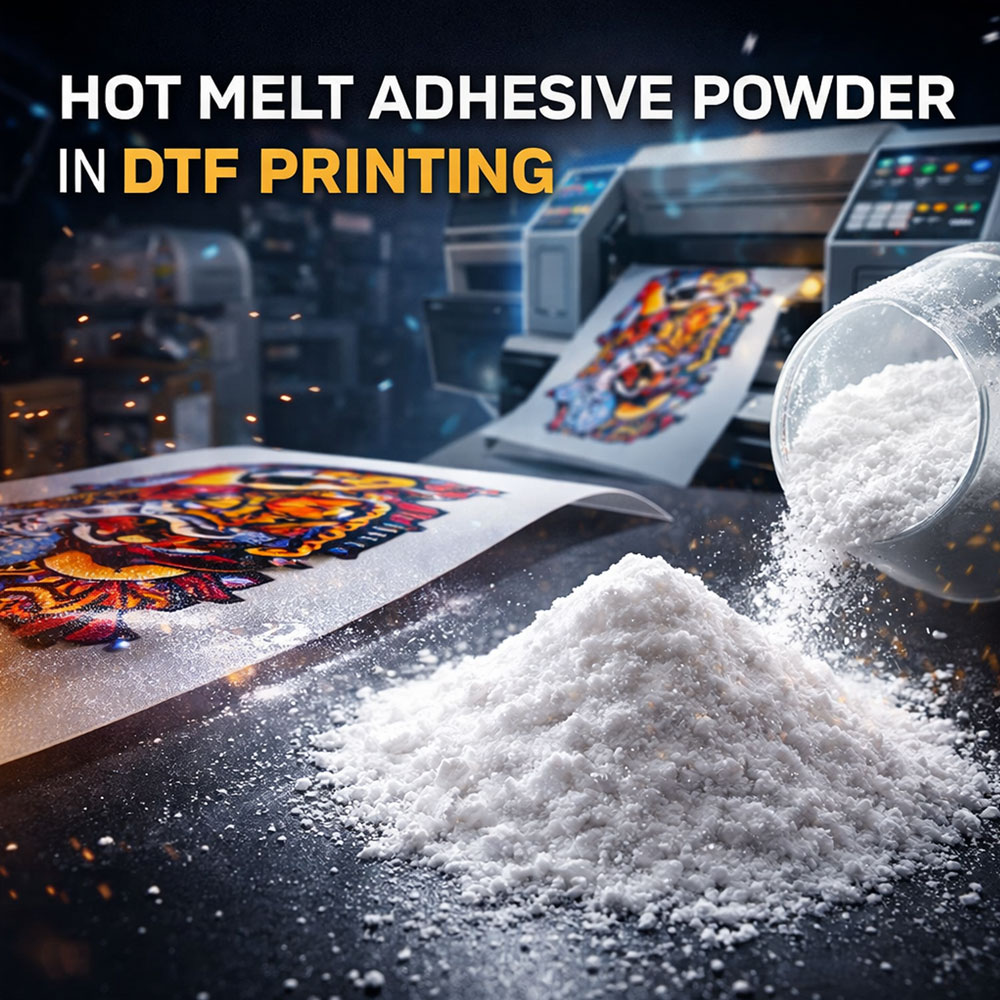
1. The Most Important Component Nobody Talks About
DTF printing is often described as a breakthrough in textile customization—but most discussions focus on printers, inks, and films.
That misses the real core.
Without hot melt adhesive powder, DTF does not work.
In fact, this material is not a supporting element—it is the binding engine of the entire process.
As DTF scales globally—driven by e-commerce, fast fashion, and on-demand production—the performance of this single material increasingly defines:
- Print durability
- Production consistency
- Customer satisfaction
2. What Hot Melt Powder Really Is
Hot melt adhesive powder is a thermoplastic polymer-based material—commonly made from polyurethane (TPU), polyamide, or similar compounds.
Its behavior is simple but powerful:
- Solid at room temperature
- Melts into a viscous adhesive under heat
- Solidifies again to create a strong bond
In DTF workflow:
- Ink is printed onto PET film
- Powder is applied to wet ink
- Heat melts the powder
- The design bonds to fabric during transfer
This transforms printed ink into a wearable, durable layer.
3. The Real Function: More Than Just Adhesion
Most explanations reduce the powder to “glue.” That is incomplete.
Hot melt powder simultaneously controls:
Adhesion Strength
It ensures the design sticks firmly to fabric and does not peel after washing.
Durability
Properly cured powder enables prints to withstand repeated washing, friction, and environmental exposure.
Flexibility & Feel
High-quality powder maintains softness and elasticity, preventing cracking or stiffness.
Color Integrity
It stabilizes ink layers, preserving vibrancy and edge definition.
This is the key insight:
DTF quality is not defined by the printer—it is defined by the adhesive layer.
4. The Science of Bonding: Why It Works So Well
Hot melt powder operates through phase transformation:
- When heated (~100–160°C), particles melt into a liquid adhesive
- The adhesive penetrates fabric fibers
- Upon cooling, it solidifies into a flexible polymer network
This creates a mechanical + chemical bond, far stronger than surface-level adhesion.
Unlike inks or coatings, this bond becomes part of the fabric structure itself.
5. Powder Types: Small Differences, Big Impact
Not all powders are equal.
They are typically classified by particle size:
- Fine powder → smooth finish, ideal for detailed graphics
- Medium powder → balanced performance
- Coarse powder → stronger adhesion for heavy fabrics
There are also specialized variants:
- Anti-sublimation powder (for polyester)
- Stretch powders (for sportswear)
- Low-temperature powders (for delicate fabrics)
This diversity reveals an important shift:
DTF is evolving from a process into a material-engineering system.
6. The Hidden Variables That Control Success
In real production, most failures are not caused by machines—but by powder handling.
Critical factors include:
- Curing temperature → incomplete melting leads to peeling
- Powder distribution → uneven coating causes defects
- Humidity control → affects powder adhesion behavior
- Timing → delayed application reduces bonding quality
Even slight deviations can result in:
- Weak adhesion
- Surface roughness
- Glue residue or edge defects
This is why experienced operators treat powder control as a precision process, not a simple step.
7. Why DTF Powder Is Driving Industry Adoption
DTF’s explosive growth is directly tied to this material’s capabilities:
Universal Compatibility
Works on cotton, polyester, blends, leather, and more
Strong Wash Resistance
Maintains integrity after dozens of wash cycles
Soft Hand Feel
Preserves fabric flexibility and comfort
Process Simplicity
No pre-treatment required, reducing workflow complexity
This combination makes DTF one of the most scalable solutions in modern garment printing.
8. Breaking the Industry’s Biggest Misunderstanding
Most people think:
“DTF is a printing technology.”
That is wrong.
DTF is actually:
An adhesive-driven transfer system.
The printer creates the image—but the powder determines whether that image:
- Stays or peels
- Cracks or stretches
- Fades or lasts
9. The Future: From Consumable to Core Technology
Hot melt powder is evolving rapidly:
- Eco-friendly, solvent-free formulations
- Lower-temperature curing systems
- Smart powders engineered for specific fabrics
In the future, we will likely see:
- AI-controlled curing profiles
- Material-specific adhesive optimization
- Integrated powder-ink co-design
This means the “consumable” will become the core innovation layer.
10. Final Insight
DTF printing looks like a digital process—but its success depends on material science.
Hot melt adhesive powder is the bridge between:
- Ink and fabric
- Design and durability
- Concept and reality
And that leads to a simple but powerful truth:
In DTF printing, the weakest layer defines the entire product.
And the strongest layer is the one you never see. -
AuthorPosts
- You must be logged in to reply to this topic.