
Home › Forums › DTF Printer Hub › Digital Textile Printing: Not Just an Upgrade, But a Structural Revolution
- This topic is empty.
-
AuthorPosts
-
2 April 2026 at 5:24 pm #1052
Dowinsss
Keymaster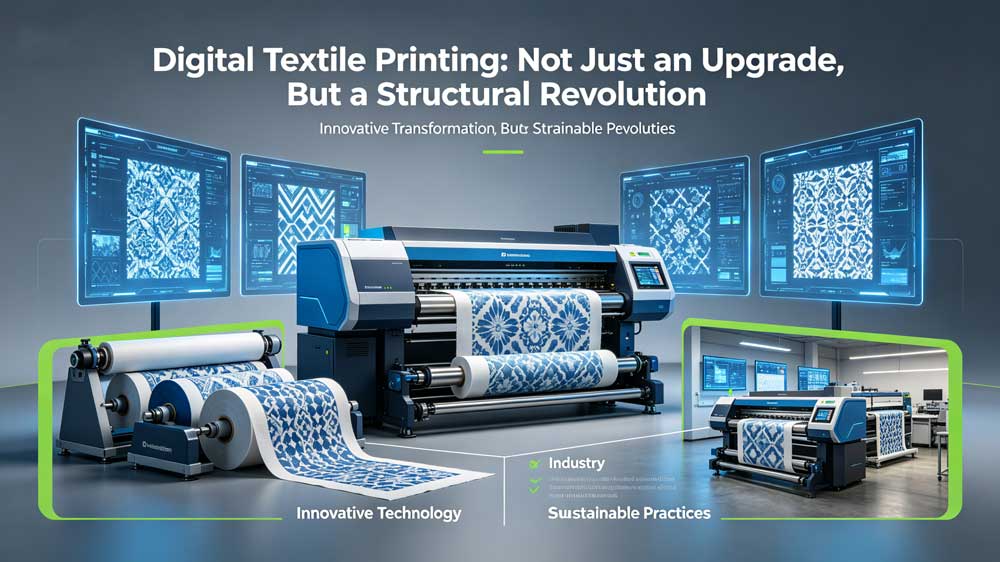
In most discussions, digital textile printing is framed as a “better alternative” to traditional methods. That view is too conservative. Based on industry data and market evolution, digital textile printing is not just an improvement—it is a fundamental restructuring of how textiles are produced, distributed, and consumed.
1. From Mass Production to Demand-Driven Manufacturing
Traditional textile printing was built on scale: large volumes, long lead times, and heavy inventory. Digital printing breaks this logic entirely.
With file-based workflows and zero setup requirements, manufacturers can shift to on-demand production, producing only what is needed, when it is needed. This eliminates overproduction—a chronic issue in fashion and textile supply chains.
Data shows that digital printing enables small-batch and real-time production, allowing rapid response to trends without inventory risk . In contrast, traditional models often lock businesses into forecasting errors and excess stock.
Personal insight:
The real value of digital printing is not speed—it is decision flexibility. It allows businesses to delay commitment until demand is confirmed. That alone reshapes profitability.
2. Sustainability Is Not a Feature—It’s the Core Advantage
The textile industry has long been one of the most resource-intensive sectors. Digital textile printing directly addresses this.
- Water consumption can drop by up to 90% compared to traditional processes
- Chemical usage can be reduced by over 80%
- Energy consumption can decrease by around 30%
Traditional textile production contributes significantly to industrial water pollution and resource waste, while digital processes minimize wastewater and chemical discharge .
Breaking conventional thinking:
Sustainability is often marketed as a “bonus.” In reality, it is becoming a mandatory economic driver. Regulations, consumer pressure, and ESG frameworks are turning sustainability into a cost factor. Digital printing wins not because it is greener—but because it is economically aligned with future compliance.
3. Creativity Becomes Scalable
Digital textile printing removes traditional design constraints:
- Unlimited colors and complex patterns
- No screens or plates required
- Instant design modification
This enables mass customization, where every product can be different without increasing production complexity.
Industry insights highlight that digital printing allows brands to rapidly test and launch new designs, supporting fast fashion cycles and niche markets simultaneously .
Personal viewpoint:
This is where digital printing quietly disrupts the market. It transforms creativity from a cost center into a competitive weapon. The brands that win are not those who produce more—but those who iterate faster.
4. Supply Chain Compression and Cost Reconfiguration
Traditional cost models focus on “cost per meter.” Digital printing changes the equation to “cost per sale.”
Why?
- No inventory storage
- Reduced logistics and warehousing
- Fewer unsold goods
- Faster time-to-market
Digital workflows simplify production and reduce supply chain complexity, leading to lower overall operational costs despite potentially higher per-unit printing costs .
Key shift:
Digital textile printing does not always lower production cost—it lowers total business risk.
5. Waste Reduction Is a Competitive Edge
Waste is one of the least discussed but most expensive problems in textile manufacturing.
Digital printing minimizes waste through:
- Precise ink placement
- No plate or screen waste
- Fewer failed samples
- On-demand production
This significantly reduces material loss and improves efficiency .
Deeper insight:
Waste reduction is not just environmental—it directly improves margins. In a low-margin industry like textiles, this is a decisive advantage.
6. Market Growth Signals a Structural Shift
The data confirms that this is not a niche trend:
- The digital textile printing market is projected to reach $7.9 billion by 2030, growing at ~14.8% CAGR
- Demand is driven by customization, sustainability, and faster delivery cycles
This growth is not driven by technology alone—it is driven by changing consumer behavior: personalization, immediacy, and environmental awareness.
Final Perspective: Digital Printing Is Rewriting Industry Logic
Most articles ask: “Why is digital textile printing beneficial?”
A better question is: “Why would the industry continue using traditional methods?”Digital textile printing delivers:
- Flexibility instead of rigidity
- Data-driven production instead of forecasting
- Sustainability instead of regulatory pressure
- Creativity without cost penalties
Conclusion:
Digital textile printing is not just a tool—it is a transition from industrial-era manufacturing to a responsive, data-driven production ecosystem. Companies that still treat it as an optional upgrade are already behind. -
AuthorPosts
- You must be logged in to reply to this topic.