
Home › Forums › DTF Printer Hub › A3 DTF Printers: Unlocking Scalable Customization Across Industries
- This topic is empty.
-
AuthorPosts
-
27 March 2026 at 7:10 pm #1032
Dowinsss
Keymaster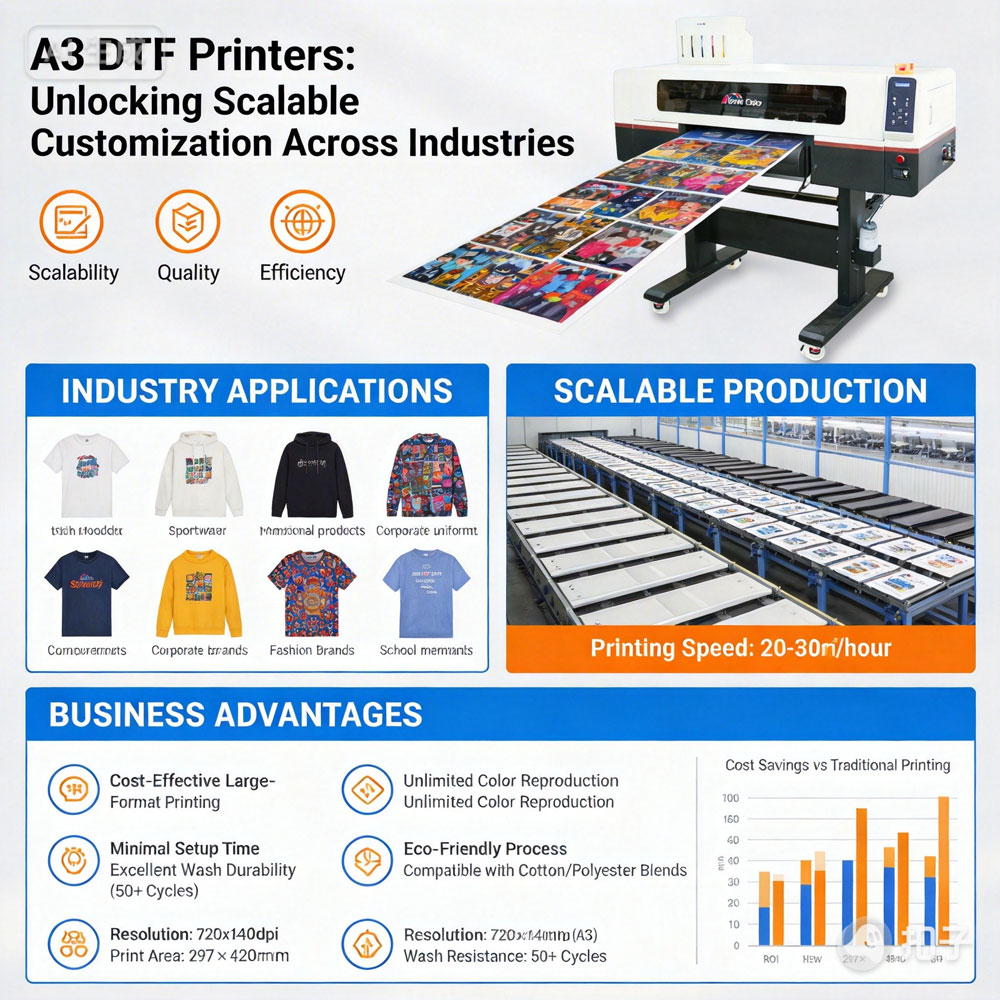
1. The “Mid-Scale” Machine Driving a Big Shift
A3 DTF printers sit in a strategic position between entry-level hobby equipment and industrial production systems.
They are not defined by size alone (297 × 420 mm), but by what that size enables:
- Full-front garment printing
- Batch production efficiency
- Higher output per film cycle
In fact, A3 has quietly become the economic sweet spot for small-to-medium print businesses—large enough for commercial work, compact enough for flexible operations.
2. The Core Logic: Why A3 Matters More Than A4
The difference between A3 and smaller formats is not incremental—it is structural.
With A3 format, operators can:
- Print multiple small designs in one run
- Produce larger graphics without splitting layouts
- Reduce film waste and reload frequency
This leads to a direct outcome:
Higher throughput with lower operational friction.
For growing businesses, this is often the tipping point between “side business” and scalable production.
3. Where A3 DTF Printers Are Actually Used
1. Custom Apparel Production (Core Market)
The dominant application remains clothing:
- T-shirts, hoodies, sweatshirts
- Sportswear and uniforms
- Fashion and streetwear
A3 DTF enables high-resolution, full-color designs with strong wash durability and compatibility across cotton, polyester, and blends.
More importantly, it enables on-demand production, eliminating inventory risk.
2. Home Textile Customization
A less obvious but rapidly growing segment:
- Cushions, curtains, tablecloths
- Decorative fabrics and soft furnishings
DTF allows interior brands and small creators to offer personalized home products without large production runs.
3. Promotional Products & Small Goods
A3 DTF extends beyond garments into:
- Tote bags and canvas items
- Caps and accessories
- Gift products
Because designs are transferred via film, businesses can diversify without investing in new printing systems.
4. Non-Fabric Applications (The Hidden Opportunity)
With proper transfer techniques, DTF can also be applied to:
- Wood
- Ceramics
- Metal sheets
- Certain plastics
This opens an entirely different market:
DTF as a universal surface decoration method.
4. The Real Advantage: Business Model Flexibility
DTF is not just a printing method—it is a business enabler.
A3 systems allow:
- One-piece customization
- Small-batch production
- Rapid design testing
- Print-on-demand fulfillment
This aligns perfectly with modern commerce:
- E-commerce
- Creator brands
- Personalized merchandise
The key shift:
Production no longer follows demand—
it responds to demand in real time.
5. Manual vs Automatic: Two Different Worlds
A3 DTF systems generally fall into two categories:
Manual Systems
- Lower cost
- Flexible for small jobs
- Operator-dependent quality
Automated Systems
- Higher speed and consistency
- Reduced labor
- Scalable for large orders
This creates a clear evolution path:
Startup → Semi-automation → Full production line
6. The Hidden Complexity Behind “Simple Printing”
DTF is often marketed as easy. Reality is different.
Performance depends on:
- Ink consistency (especially white ink)
- Powder application uniformity
- Curing temperature control
- Workflow synchronization
Even high-end A3 machines fail if these variables are not controlled.
This leads to a critical insight:
DTF success is process-driven, not machine-driven.
7. Breaking the Industry’s Old Thinking
Traditional printing logic:
- Invest in large machines
- Produce in bulk
- Manage inventory
A3 DTF reverses this:
- Produce only what is ordered
- Scale gradually
- Minimize waste
This is not just efficiency—it is a new production philosophy.
8. The Strategic Role of A3 in the Industry
A3 DTF printers are not the endgame.
They are the bridge:- From hobby → business
- From manual → automated
- From local → scalable
They enable businesses to test markets, refine workflows, and grow without heavy upfront risk.
9. Final Insight
A3 DTF printers are often underestimated as “mid-size machines.”
That misses the point.
They are actually:
- Entry points to industrial thinking
- Tools for flexible manufacturing
- Platforms for scalable customization
The future of printing will not be dominated by the biggest machines.
It will be shaped by this capability:
The ability to produce anything, at any time, in any quantity—on demand.
-
AuthorPosts
- You must be logged in to reply to this topic.