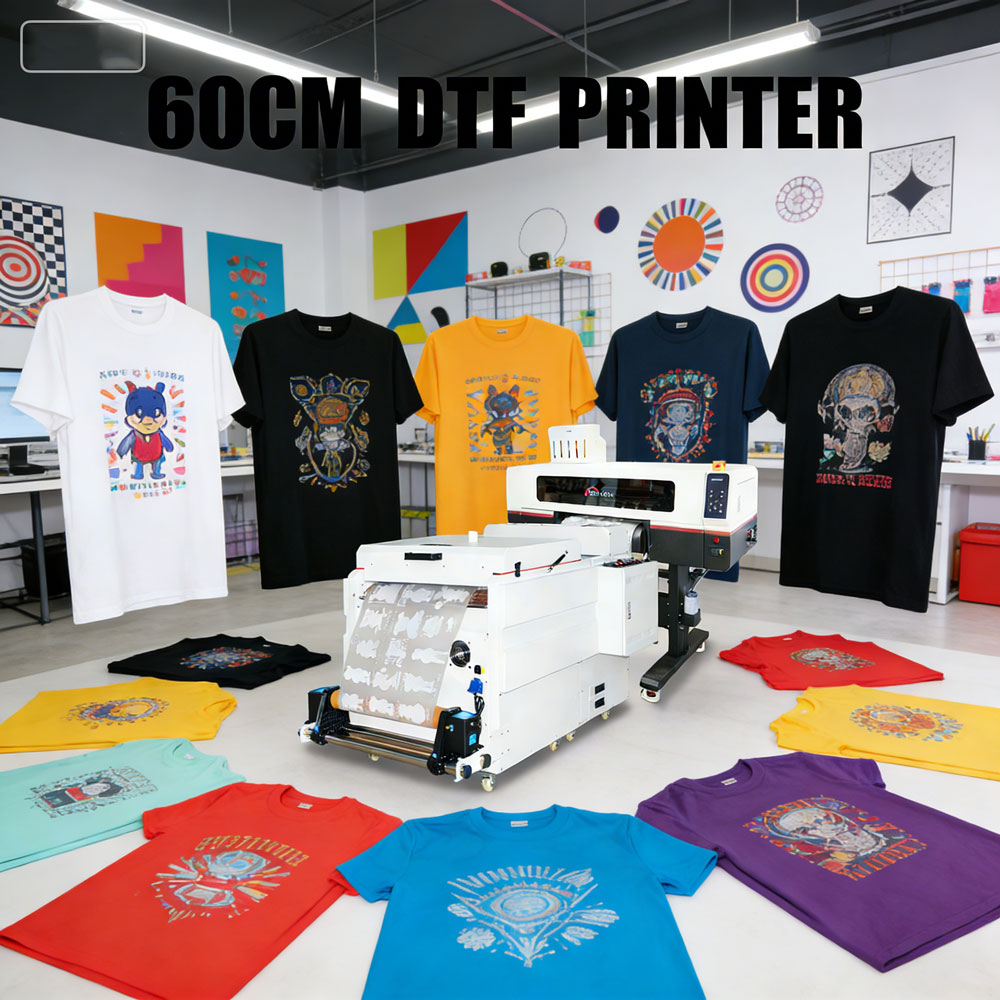
Choosing the right direct-to-film (DTF) printer involves more than picking the number of print heads. The number of heads affects production speed, color quality, operational complexity, and total cost of ownership. This comparison helps you decide which configuration makes sense for your business goals — whether you’re just starting out or scaling up production.
DTF printing itself has transformed garment decoration because it doesn’t require pretreatment, works on almost all fabric types, and delivers colorfast prints with good wash durability. It prints onto a specialized PET film, applies hot-melt adhesive powder, and then heat-presses the design onto fabric — creating vibrant results across cotton, polyester, blends, denim, leather, and more.
Contents
Understanding 2-Head DTF Printers
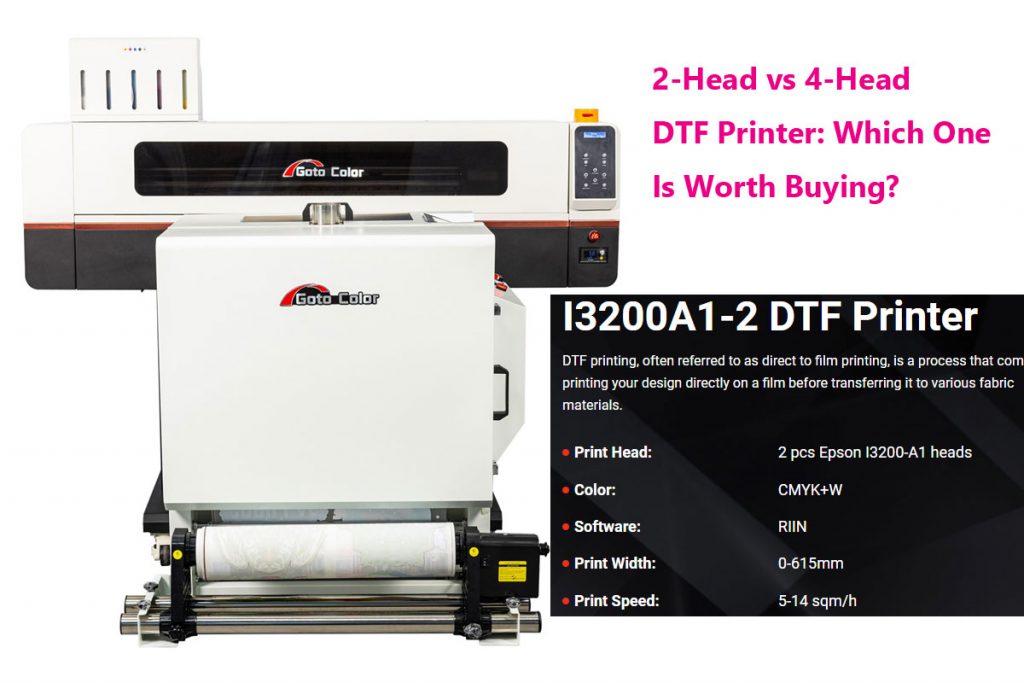
A 2-head DTF printer has two print heads working in tandem. These machines tend to be more affordable and easier to operate. They generally use basic CMYK + white ink channels and handle small to moderate workloads.
Strengths
- Lower upfront cost: 2-head machines are easier on the budget, especially if you’re launching a business or working with limited capital.
- Simpler operation: Fewer heads mean less complexity in setup, fewer parts to maintain, and a gentler learning curve for beginners.
- Compact footprint: Typically smaller and lighter than multi-head machines, they suit smaller studios or home setups with limited floor space.
- Versatile for varied jobs: Ideal for one-off orders, small batches, or a mix of products like T-shirts, hoodies, bags, and accessories.
Limitations
- Moderate speed: Production speeds are respectable for small businesses but are noticeably slower than what multi-head machines deliver.
- Standard color gamut: With fewer ink channels, the color range and gradient smoothness are good but may be less refined in ultra-complex, high-detail designs.
- White ink performance: White ink layers — crucial for vivid prints on dark fabrics — tend to be less dense compared to higher-head machines.
Best for: Startups, small studios, and businesses printing low to moderate volumes with flexible product lines.
Understanding 4-Head DTF Printers
A 4-head DTF printer uses four print heads to increase throughput and expand the color range. These machines are designed for higher production capacity and superior color accuracy.
Strengths
- Twice the output: With four heads working simultaneously, print speed often nearly doubles compared to dual-head models, making them ideal for larger batch volumes.
- Enhanced color range: A broader set of ink channels and more heads improve tonal range, gradient detail, and color consistency.
- Better white ink coverage: The extra print heads allow for thicker, more uniform white layers, which improves opacity on dark fabrics.
- Scalability: Designed for commercial workflows, they integrate well into automated production lines with rollover systems and advanced control features.
Drawbacks
- Higher initial investment: Four heads and the associated electronics raise the purchase price — sometimes significantly compared to 2-head models.
- More complex maintenance: More components mean greater maintenance demands and a steeper learning curve for routine upkeep.
- Larger footprint: These machines often require more floor space and supporting infrastructure (power, ventilation, workflow organization).
Best for: Established print shops, medium to large-sized operations, and businesses that consistently fulfill high volumes.
Side-by-Side Comparison
| Feature | 2-Head DTF Printer | 4-Head DTF Printer |
|---|---|---|
| Production Speed | Moderate (good for small batches) | High (excellent for large batches) |
| Color Performance | Standard color gamut | Expanded gamut and smoother gradients |
| White Ink Density | Moderate | High |
| Learning Curve | Easier | More advanced |
| Cost | Lower | Higher |
| Maintenance | Simpler | More demanding |
| Floor Space | Smaller | Larger |
Real-World Considerations and Personal Insights
1. Scalability vs Flexibility
If your business is primarily about custom orders with unpredictable volume, the 2-head model gives you flexibility, lower risk, and better cash flow early on. Once your orders consistently exceed what a 2-head machine can handle in a day, it makes sense to upgrade to 4 heads to unlock true scalability. This avoids paying for unused capacity and underutilized equipment.
2. Production Efficiency Matters
The real yardstick isn’t print speed specs — it’s turnaround time per batch. In practice, a 4-head printer can run two to three times faster on identical jobs, meaning more shirts, transfers, or prints leave your shop each day. This is crucial if you’re targeting bulk contracts or contract printing clients.
3. Maintenance and Reliability
Adding more heads increases points of potential failure. A particularly insightful industry observation is that four heads don’t just double maintenance — they escalate complexity because issues (like nozzle clogs) impact multiple heads at once. For small operations without dedicated technical support, a 2-head system may be significantly less stressful to run.
4. Long-Term ROI
Yes, 4-head machines require more capital. But if you consistently run high volumes, they often pay for themselves through greater throughput and lower cost per print. The key question: Are you ready to use that capacity every day? If yes, the investment can be justified; if not, the unused value sits idle and eats profit.
Final Recommendation
Start small if you’re new and uncertain: A 2-head DTF printer keeps your risk low, your learning curve manageable, and your capital investment reasonable. This setup suits typical home studios and fledgling print businesses.
Go big if you have a proven demand: If your business already turns consistent orders and you struggle to keep up with daily production goals, a 4-head system delivers efficiency, speed, and an extended color range that pays dividends in volume and client satisfaction.
Practical Buying Tips
- Test prints from both configurations before buying to evaluate real print quality differences.
- Plan your workspace layout to ensure machines fit with proper ventilation and access.
- Assess consumable costs (ink, film, powder) as these can affect long-term profitability more than the printer itself.
- Invest in good RIP software — print outcomes are as dependent on workflow software as on hardware.