Home › Forums › Digital UV Printing Hub › What You Can Make with a UV Printer
Tagged: UV Printer
- This topic is empty.
-
AuthorPosts
-
13 January 2026 at 8:03 pm #812
Dowinsss
KeymasterWhat You Can Make with a UV Printer
A Comprehensive Industry-Level View of Creative & Commercial Applications
Ultraviolet (UV) printing has rapidly evolved from a specialist industrial technology into a versatile solution for creative, commercial, and manufacturing workflows. Instead of relying on heat or evaporation to dry inks, UV printing uses ultraviolet light to cure inks instantly on contact with a surface. This capability allows direct printing on a wide range of materials with strong adhesion, vibrant color, and durability. The result is not just efficient production, but a dramatic expansion in what can be created and monetized across industries.
Core Advantages of UV Printing Technology
Broad Material Compatibility
UV printers can print on substrates including plastics, metals, wood, glass, acrylic, ceramics, stone, foams, and rigid boards. This flexibility unlocks applications impossible with conventional paper-focused printing systems.Instant Curing for Efficiency
Since UV inks cure immediately under UV light, there’s no drying time. This not only speeds production but reduces smudging and setup complexity, making short runs and on-demand customization commercially viable.Environmental Benefits
UV inks are often free of volatile organic compounds (VOCs) and require less energy to cure than solvent systems, aligning with broader industry trends toward greener printing processes.What You Can Make with a UV Printer
1. Signage & Large-Format Displays
UV printers are widely used for retail signage, banners, exhibition boards, trade show displays, and directional signage. The ability to print directly onto rigid materials like PVC, aluminum, and foam core produces durable indoor and outdoor graphics with excellent weather resistance.
This application underpins many commercial print shops and is a stable revenue generator due to repeat business from retail chains, events, and marketing agencies.
2. Custom Packaging & Prototyping
Brands increasingly demand custom packaging even in short runs or limited editions. UV printers allow for direct printing on cardboard, plastics, wood, or composite packaging structures, eliminating plate-making and enabling rapid prototype visualization.
In markets like consumer goods and luxury products, tailored packaging with textured, embossed, or metallic effects drives higher perceived value and shelf impact.
3. Promotional & Personalized Products
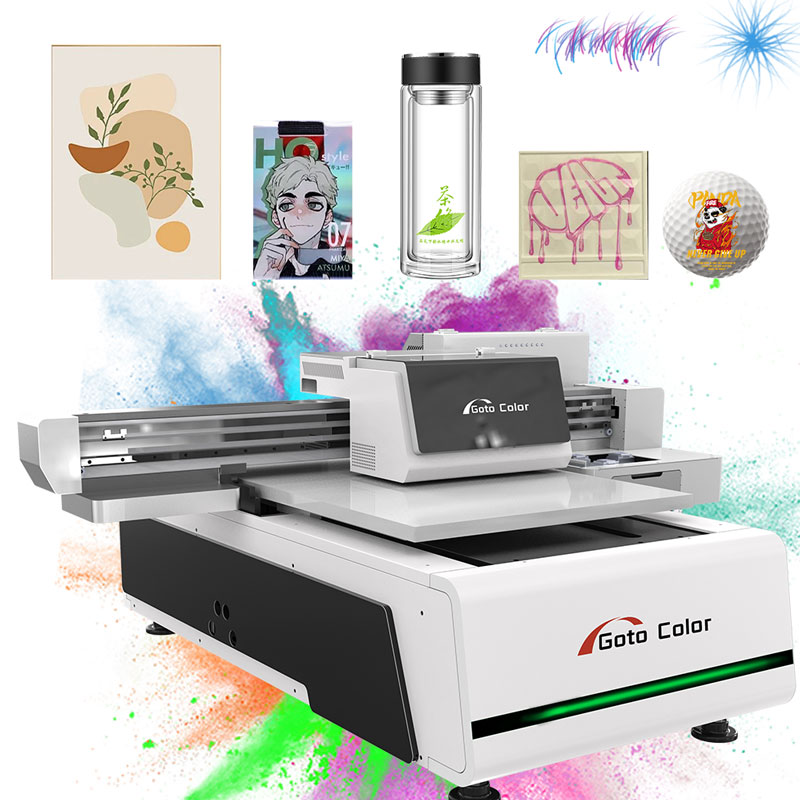
One of the fastest-growing applications is personalized gift items and promotional merchandise. UV printing can directly decorate objects such as:
-
Customized phone cases and tech accessories
-
Branded drinkware (tumblers, mugs, bottles)
-
Promotional plaques, coasters, keychains, and corporate gifts
-
Awards and recognition plates
Because UV printing can apply full-color graphics on irregular shapes, businesses can offer unique products with high customer appeal.
4. Interior Design & Decor
Interior designers and decorators use UV printing to create custom wall art, decorative tiles, glass panels, wooden furniture elements, and architectural accents. By printing detailed patterns or imagery directly onto surfaces that will be installed as part of built environments, this technology bridges functional manufacturing and artistic expression.
5. Industrial & Component Marking
In manufacturing settings, UV printing serves practical functions such as labeling components, printing part numbers, safety labels, and functional graphics on metal or polymer parts. This kind of direct marking avoids secondary processes like stickers or pad printing and adds durability against abrasion and solvents.
6. Art Reproduction & Specialty Printing
Artists and print studios use UV technology for fine art reproduction, photographic prints, and textured graphic work. Some advanced printers can apply raised layers of ink for tactile effects, blending visual art with sculptural depth without secondary embossing processes.
7. Niche & Emerging Products
UV printing continues to expand into niche markets as technology evolves:
-
Helmet and protective gear decoration
-
Toy and novelty item graphics
-
Custom signage on curved surfaces
-
Home craft and small-batch artisan products
These emerging use cases demonstrate that UV printing isn’t limited to traditional print shop outputs but integrates into creative industries and maker economies.
Why This Matters Now
The expansion of UV printing reflects broader shifts in manufacturing and consumer demand:
-
On-demand production is replacing large-run “make and stock” models.
-
Customization and personalization drive higher margins in both B2B and B2C markets.
-
Cross-industry adoption means print technology is now integral to product design, packaging, decor, and industrial workflows.
In my view, UV printing represents a convergence point between traditional printing, digital fabrication, and direct product manufacture. Its adoption signifies not just a tool upgrade, but a strategic enabler for businesses looking to innovate with visual and physical products across industries.
Summary of Typical UV Printer Outputs
Category Examples of Products Signage & Display Retail signs, banners, trade show boards Packaging Custom boxes, label prototypes Promotional Items Personalized gifts, branded merchandise Decor Wall panels, tiles, furniture accents Industrial Component marking, machine panels Art & Specialty Fine art prints, textured prints Niche Goods Helmets, toys, surface graphics
This brand-free overview highlights not only what you can make with a UV printer but also why the technology has become indispensable in modern visual production and manufacturing workflows.
-
-
AuthorPosts
- You must be logged in to reply to this topic.