
Home › Forums › Digital UV Printing Hub › UV Flatbed Printing on Metal: Reliability Factors
Tagged: Printing on Metal
- This topic is empty.
-
AuthorPosts
-
12 March 2026 at 1:17 pm #978
Dowinsss
KeymasterIn the past decade, industrial customization has shifted dramatically. Global demand for personalized metal products—from stainless steel signage to anodized aluminum electronics—has surged alongside the growth of e-commerce and on-demand manufacturing. According to multiple industrial printing reports, the digital direct-to-object printing market is expanding at more than 8–10% annually, with metal substrates becoming one of the fastest-growing segments.
Yet one fundamental question still troubles manufacturers and entrepreneurs: How reliable is metal printing with a mid-size UV flatbed printer?
The answer is more complex than simply choosing a machine. Reliability in metal printing is actually the result of three interdependent factors: equipment stability, material preparation, and process control.
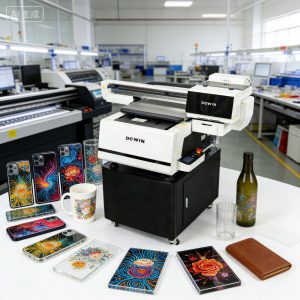
The Real Challenge of Printing on Metal
Metal surfaces are fundamentally different from materials such as wood, plastic, or coated paper. Unlike porous substrates, metal is dense, smooth, and non-absorbent, which makes ink adhesion inherently difficult. If the process is not properly optimized, several problems can occur:
-
Ink peeling or scratching
-
Poor color saturation
-
Uneven curing or smearing
-
Reduced long-term durability
These issues often lead beginners to believe that metal printing itself is unreliable. In reality, the instability usually comes from improper workflow rather than the technology itself.
Industrial data shows that successful metal printing depends on a combination of:
-
Stable printing hardware
-
Correct surface preparation
-
High-quality inks and coatings
When these three factors are aligned, UV printing on metal can achieve durability comparable to traditional industrial marking processes.
Hardware Stability: The Foundation of Consistent Output
Modern UV flatbed printers designed for industrial use rely on precision printheads and controlled ink delivery systems. These components determine whether the machine can maintain accuracy during long production runs.
Industrial-grade printheads, for example, are typically constructed with corrosion-resistant metal structures that allow them to operate for several years under heavy workloads. Their variable droplet technology can produce different ink dot sizes, enabling both fine image detail and smooth color gradients.
Another critical element is the negative-pressure ink supply system. By maintaining stable pressure within the ink channels, the system prevents two common production failures:
-
Ink starvation during continuous printing
-
Nozzle clogging after long jobs
With a stable ink flow, manufacturers can run batch production of metal labels, control panels, or decorative panels without constant recalibration.
In other words, reliability in industrial printing often comes down to mechanical precision and ink management, not just the advertised print resolution.
Color Complexity: Why Modern Metal Printing Looks Better Than Ever
A second factor influencing reliability is color control. Traditional digital printing often relied on a basic CMYK configuration. However, many modern flatbed printers now use expanded color systems.
Advanced configurations may include additional light inks, white ink layers, and varnish channels. These allow printers to achieve:
-
Higher color accuracy
-
Stronger contrast on dark metal surfaces
-
Decorative textures and raised effects
White under-printing is particularly important when working with dark metals such as black titanium or brushed aluminum. By laying down a white base layer first, the printer prevents color distortion and ensures the final image maintains its intended appearance.
Some systems can even stack multiple ink layers to create 3D embossed textures, transforming flat metal plates into tactile decorative surfaces.
This capability has opened new opportunities in luxury packaging, custom awards, and architectural metal panels.
The Often-Ignored Secret: Surface Preparation
Even the most advanced printer cannot compensate for a poorly prepared substrate. Surface preparation is arguably the most critical step in metal printing.
A reliable workflow typically includes three stages:
1. Surface Cleaning
Oil, grease, or dust must be removed from the metal surface before printing. Any contamination can interfere with ink bonding.
2. Adhesion Coating
A specialized primer or coating is often applied to modify the surface tension of the metal. This layer enables the UV ink to bond strongly at a molecular level.
3. Instant UV Curing
UV LED lamps cure the ink immediately after deposition, forming a hardened layer that resists scratching and environmental exposure.
Skipping any of these steps drastically reduces print durability.
Where Metal UV Printing Is Being Used Today
Reliable UV metal printing has already become a core production technology in several industries:
Industrial identification
Machine panels, equipment labels, and stainless steel safety signs require durable graphics that resist chemicals and abrasion.Awards and commemorative items
Metal medals, plaques, and trophies often use textured UV printing to create visually striking surfaces.Consumer electronics customization
Aluminum accessories such as phone cases, power banks, and smart device housings increasingly feature direct-printed graphics.Architectural decoration
Elevator panels, decorative metal walls, and interior art installations now frequently incorporate digitally printed imagery.These applications demonstrate that metal printing is no longer limited to niche craftsmanship—it is becoming a scalable industrial process.
A New Perspective: Reliability Is a System, Not a Machine
One of the biggest misconceptions in digital manufacturing is that reliability comes from buying a “better printer.” In reality, reliability is an ecosystem.
The machine provides the platform, but the final outcome depends on:
-
material preparation
-
ink chemistry
-
curing control
-
operator workflow
Businesses that treat metal printing as a complete production system—not just a device—consistently achieve higher quality and fewer failures.
Final Thoughts
Metal used to be considered one of the most difficult substrates for digital printing. Today, advances in UV curing technology, precision printheads, and coating chemistry have transformed it into a viable medium for mass customization.
With proper process control, modern flatbed printing systems can deliver durable, high-definition images directly on metal surfaces, enabling manufacturers to produce everything from industrial signage to luxury decorative panels.
The real breakthrough is not the machine itself—it is the realization that digital printing and metal fabrication are converging into a single manufacturing workflow. Businesses that understand this shift will be the ones defining the future of customized metal products.
-
-
AuthorPosts
- You must be logged in to reply to this topic.