
Home › Forums › Digital UV Printing Hub › Understanding DTF Transfers: Printers, Consumables, Workflow, and Industry Context
Tagged: DTF Transfers
- This topic is empty.
-
AuthorPosts
-
15 January 2026 at 8:24 pm #818
Dowinsss
KeymasterUnderstanding DTF Transfers: Printers, Consumables, Workflow, and Industry Context
What Is Direct-to-Film (DTF) Printing?
Direct-to-Film (DTF) printing is a textile decoration process in which digital designs are printed onto a specially coated polymer film, treated with adhesive powder, cured, and then heat-pressed onto garments or other substrates. The film acts as an intermediary, separating the printing phase from garment finishing, and allowing flexible scheduling and batch production. This method differs from direct-to-garment (DTG) printing because it does not require fabric pre-treatment and can adhere to a wide range of materials, including cotton, polyester, nylon, and blends. Also read What Is DTF Heat Transfer? A Complete Overview
DTF’s versatility, combined with relatively simple workflow and full-colour capability, has made it attractive for startups, custom shops, and established producers alike.
How the DTF Process Works
At its core, the DTF workflow includes:
-
Design Preparation – Artwork is prepared in RIP software that handles full-colour graphics and white underbase generation.
-
Printing on Film – Pigment-based inks (typically cyan, magenta, yellow, black, plus white) are deposited onto the special PET film. White ink forms a base layer enabling vibrant colours on both light and dark fabrics.
-
Powder Application – A thermoplastic adhesive powder is applied to the wet printed surface. Particle size and even coverage are key quality factors.
-
Curing – The adhesive powder is melted and fused to the ink layer using a curing unit or heat press.
-
Heat Transfer – The prepared film is positioned on the garment and heat-pressed, adhering the design to the fabric.
Because the transfer and curing steps are separate from the garment pressing stage, DTF allows production batching—printing many transfers ahead of finishing—which improves workflow flexibility.
Key Components of a DTF Workflow
Printers and Print Stations
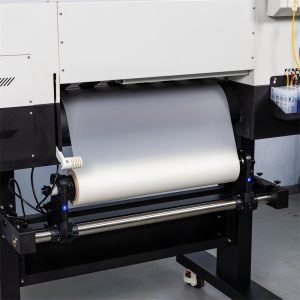
DTF printers range from compact desktop units suitable for small orders to wide-format, multi-head machines designed for high throughput. Core considerations when selecting a printer include:
-
Print Width & Throughput: Matches your expected volume and garment size range.
-
Ink Delivery & White Ink Support: Consistent white ink circulation and layered printing ensure opacity and colour accuracy.
-
Environmental Control: Stable temperature and humidity improve print consistency and prevent nozzle blockages.
Industry trends show a rapid increase in the adoption of dedicated DTF systems over modified general-purpose printers because of reliability and lower maintenance overheads.
Consumables: Film, Inks & Adhesive Powder
DTF consumables profoundly affect quality, durability, and cost efficiency:
-
Film: Specially coated PET film is engineered to accept ink and release it cleanly during heat transfer.
-
Inks: Modern pigment inks are formulated for colour vibrancy, wash durability, and strong adhesion to both film and fabric.
-
Adhesive Powder: Particle size distribution and melt behaviour impact hand feel, bonding strength, and elasticity.
Careful selection and controlled storage conditions (cool, dry, dust-free) can significantly reduce waste from clogged heads or adhesion defects.
Heat Press Equipment
Heat presses are essential for transferring DTF prints to substrates. Typical considerations include:
-
Temperature & Pressure Control: Accurate, uniform settings reduce transfer failures.
-
Press Type: Swing-away or clam-shell presses work for lower volumes; pneumatic or dual-station presses benefit high-throughput environments.
-
Dwell Time & Peel Method: Optimisation ensures durable adhesion and touch quality.
Real-world practice shows that while DTF is marketed as easy, achieving consistent transfers is sensitive to temperature, time, and pressure variables—often overlooked by beginners.
Maintenance & Best Practices
To maintain print quality and minimise downtime:
-
Perform daily nozzle checks and head cleanings.
-
Control workspace humidity to prevent white ink settling.
-
Empty waste tanks regularly.
-
Keep consumables properly labeled and stored.
Routine maintenance reduces costly disruptions and extends hardware life.
Industry Trends and Market Dynamics
DTF is expanding within the broader textile decoration market due to:
-
High Versatility: Works across fabrics where DTG and sublimation may struggle.
-
Cost Efficiency on Small Runs: Lower setup costs and reduced waste make DTF attractive for personalized or on-demand printing.
-
Production Flexibility: Decoupling print and press stages aligns well with batch workflows and increases throughput.
Market data indicate that DTF has moved from early adoption to mainstream printing solutions, with the global garment decoration equipment segment showing significant CAGR growth through the decade.
Challenges and Realities
While DTF offers many advantages, challenges include:
-
Quality Variability: Poor consumables or calibration can lead to adhesion failures or uneven prints.
-
Perceived Ease vs. Practical Skill: Successful transfers require precise control of multiple variables, contrary to some marketing claims.
-
Environmental & Waste Considerations: Although water-based inks and recyclable films offer sustainability potential, proper waste handling and ventilation remain critical, especially with fine polymer powders.
Conclusion
DTF printing has become a pivotal textile decoration technology by combining digital flexibility with broad substrate compatibility and cost-effective workflows. For printers seeking to enter or expand in custom apparel and promotional products, mastering the hardware, consumables, and process details is essential. While the entry barrier appears low, true operational success depends on disciplined setup, maintenance practices, and an understanding of material science—a reality that separates sustainable shops from hobbyist efforts.
-
-
AuthorPosts
- You must be logged in to reply to this topic.