
Home › Forums › DTF Printer Hub › Growing a T-Shirt Business Using a DTF Printer: A Practical Guide
Tagged: T-Shirt Business, T-Shirt Printing
- This topic is empty.
-
AuthorPosts
-
27 January 2026 at 6:24 pm #905
Dowinsss
KeymasterGrowing a T-Shirt Business Using a DTF Printer: A Practical Guide
In the apparel decoration industry, Direct-to-Film (DTF) printing has rapidly moved from a niche technology to one of the most transformative tools for small and medium-sized t-shirt businesses. With increasing customer demand for customization, short runs, and rapid fulfillment, DTF printing offers a unique combination of flexibility, quality, and profitability that many traditional methods struggle to match.
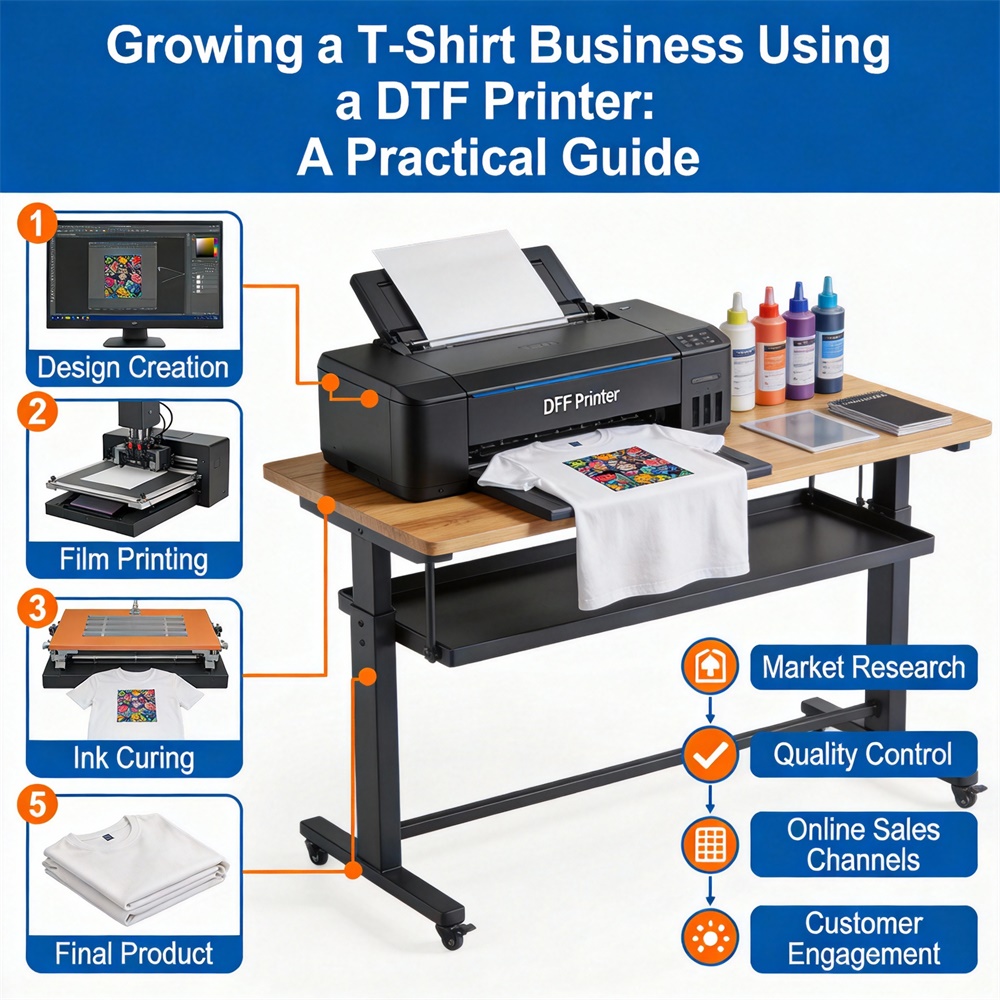
Below is a structured look at how entrepreneurs can use DTF technology to expand a t-shirt business sustainably and strategically.
1. Understanding What You Need to Get Started
At its core, a DTF setup consists of the printing device itself, heat transfer equipment, and essential consumables. Unlike older technologies, DTF doesn’t require specialized fabric pretreatment or color separation screens, simplifying entry into the business. A typical setup includes:
-
A DTF printer capable of producing high-quality pigment prints on film.
-
A heat press machine to transfer designs from film to garment at controlled pressure and temperature.
-
DTF film and adhesive powder, which bond the print to the fabric, forming durable images.
-
A computer with design software for artwork creation and layout.
-
Optional finishing equipment such as a curing oven or drying station to set the transfer before pressing.
Having the right technical foundation not only improves print quality but also enhances production speed — a key factor as order volumes increase.
2. How the Workflow Works in Practice
The DTF printing process is straightforward but differs from screen printing and direct-to-garment (DTG) techniques. Once a design is finalized digitally, it is printed onto a specialized film. After printing, adhesive powder is applied and activated through a brief curing step. The prepared film is then heat-pressed onto garments, transferring ink and adhesive in one step.
This workflow eliminates multiple traditional steps — such as pretreatment of fabrics or screen setup — reducing lead times and production complexity. For small orders or custom runs, this efficiency is a major competitive advantage.
3. Leveraging DTF for Business Growth
3.1 Broadening Your Product Range
DTF printing works on a wide variety of fabric types — from cotton and polyester to blended or performance materials — without compromising image quality. This versatility opens up new product categories such as hoodies, bags, hats, and promotional textiles, helping brands diversify revenue streams beyond basic t-shirts.
Wide material compatibility makes it especially attractive in markets where consumer preferences and fashion trends change rapidly. Being able to serve diverse product needs can significantly expand the customer base.
3.2 Improving Turnaround Time
For many small businesses, speed is a make-or-break factor. DTF printing dramatically reduces production turnaround by cutting out lengthy prep work and enabling on-demand fulfillment. In competitive industries like custom apparel, rapid delivery boosts customer satisfaction and can increase repeat sales.
Fast turnaround also enhances responsiveness to last-minute orders — such as event merchandise or seasonal campaigns — increasing the overall sales potential of the business.
3.3 Cost Efficiency and Profit Margins
DTF printing dramatically lowers operational expenses by reducing consumable usage and eliminating expensive setup steps. For example, water-based DTF inks often require less white ink than DTG printing, which translates to lower ink costs per print.
By keeping production costs down, businesses can maintain competitive pricing while protecting profit margins — a vital advantage, especially in markets driven by price sensitivity. Lower costs also make it easier for startups and small brands to enter the space without needing large upfront capital.
3.4 Enabling Scalable Growth
One of the most compelling aspects of DTF technology is how it supports scalable growth. A small business can start with an entry-level machine and expand capacity over time as demand increases — without changing the core workflow, inks, or consumables. This adaptability means owners can scale production efficiently without disruptive technology transitions.
This modular growth path is a key reason why many small t-shirt shops are adopting DTF printing as a backbone technology for expanding operations and services.
4. Strategic Business Practices With DTF
4.1 Offer On-Demand & Custom Services
Providing on-demand printing services — such as personalized t-shirts for local teams, corporate events, or celebrations — is a dynamic way to attract consistent revenue. Offering one-off custom orders differentiates a business from commodity printing providers and builds stronger customer relationships.
Running limited editions or seasonal collections adds another revenue layer and keeps product offerings fresh.
4.2 Test Trends Without Large Inventory Risk
DTF printing supports small-batch experiments without requiring large inventory commitments. This allows businesses to test new designs, niche audiences, or trending themes with minimal financial risk — an approach that aligns well with modern e-commerce and social media-influenced purchasing behavior.
Rapid sampling and iteration help businesses stay agile and relevant among competitors.
4.3 Maintain Equipment and Stay Current
While the initial investment in quality equipment can be significant, ongoing maintenance — such as regular print head cleaning and part replacement — extends machine life and improves reliability. Staying informed about technological upgrades in DTF hardware and software also helps businesses maintain competitive quality and efficiency levels.
5. Personal Insight on Market Dynamics
From a strategic standpoint, DTF printing offers an optimal balance of flexibility, quality, and cost-effectiveness for apparel businesses at almost any scale. Its ability to handle diverse materials, produce vibrant prints, and support short-run customization makes it especially powerful in today’s personalized merchandise market.
However, DTF should be viewed as part of a broader production strategy — complementary to other methods like screen printing or digital direct-to-garment printing — rather than a one-size-fits-all solution. The smartest operators deploy DTF where it has the most economic and creative advantage, while not neglecting the specialist strengths of alternative techniques.
Conclusion
Implementing a DTF printer into a t-shirt business model can unlock significant growth opportunities. By reducing production complexity, enabling on-demand fulfillment, and lowering cost per print, DTF technology empowers both startups and established operators to expand efficiently and competitively. When combined with strategic pricing, diverse product offerings, and an agile approach to customer service, DTF printing becomes a powerful engine for sustainable business expansion in the modern apparel landscape.
DTF Printing FAQ
Is DTF printing good for beginners?
Yes. DTF printing is easy to learn, requires no screen setup or fabric pretreatment, and is suitable for beginners starting a T-shirt business.What fabrics work with DTF printing?
DTF printing works on cotton, polyester, blends, denim, and many performance fabrics.How long do DTF prints last?
Properly cured DTF prints can withstand repeated washing without cracking or fading.Is DTF cost-effective for small orders?
Yes. DTF printing is ideal for small batches and custom designs because it has minimal setup costs.DTF vs DTG: which is better for business?
DTF offers better material flexibility, while DTG provides a softer feel on cotton garments.Can DTF printing scale with business growth?
Yes. DTF production is modular and can scale by adding capacity without changing the workflow.Is DTF suitable for print-on-demand?
Yes. DTF supports fast turnaround, low inventory, and frequent design changes. -
-
AuthorPosts
- You must be logged in to reply to this topic.