
Home › Forums › DTF Printer Hub › DTF vs. DTG Printing: Which Method Makes Sense for Your Business?
Tagged: DTF Printing, DTG Printing
- This topic is empty.
-
AuthorPosts
-
30 January 2026 at 5:31 pm #937
Dowinsss
KeymasterDTF vs. DTG Printing: Which Method Makes Sense for Your Business?
In custom apparel and print-on-demand markets, Direct-to-Garment (DTG) and Direct-to-Film (DTF) printing are two of the most widely used digital textile printing technologies. Each method has distinct workflows, cost structures, strengths, and trade-offs — making the choice between them essential for product quality, operational efficiency, and profitability.
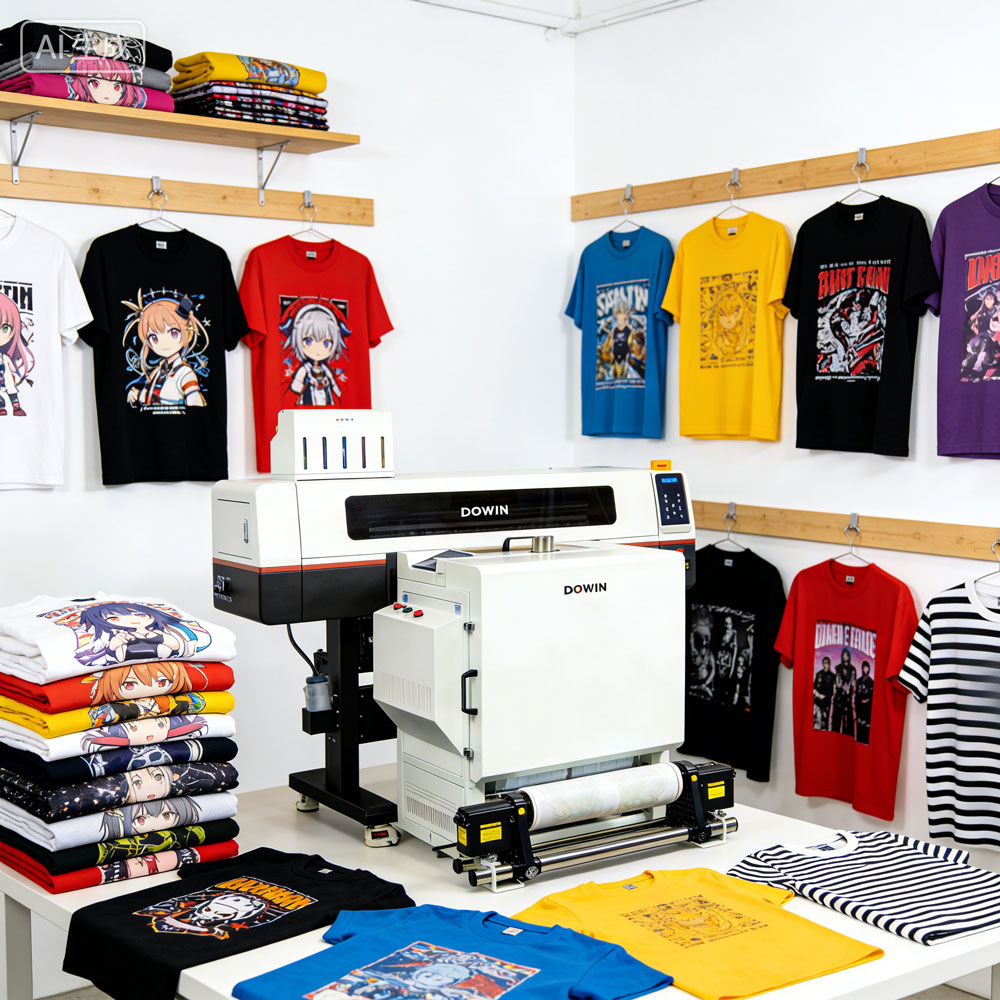
DTG has long been the standard for producing high-resolution graphics on cotton garments. In recent years, DTF — which prints designs onto a special film and then heat-presses them onto products — has surged in popularity due to versatility and lower barriers to entry.
How the Two Processes Work
Direct-to-Garment (DTG) printing operates much like a high-resolution inkjet on fabric: garments are pretreated (especially on dark materials), then ink is printed directly onto the textile and heat-cured. This method embeds ink into fabric fibers, producing a soft feel and detailed images.
Direct-to-Film (DTF) printing prints the design on a specialized PET film. After printing, an adhesive powder is applied, cured, and then the film is heat-pressed onto the garment. This transfers the design onto the material surface rather than embedding it.
Fabric Compatibility and Material Flexibility
A key distinction between DTF and DTG is fabric compatibility:
-
DTG prints best on natural fibers, especially 100 % cotton and high-cotton blends. Its water-based inks bond naturally to these fabrics but struggle on polyester or fully synthetic textiles without specialized treatments.
-
DTF works across almost all fabrics, including cotton, polyester, blends, nylon, and other synthetics, because the transfer process is not dependent on fiber chemistry.
This versatility gives DTF a clear advantage when customers want the same print method for varied material types, from athletic wear to mixed blends.
Print Quality, Feel, and Durability
DTG printed designs penetrate fabric fibers, resulting in a soft hand feel that integrates smoothly with the garment surface. This typically produces excellent detail and natural gradients, especially on light materials.
DTF transfers sit on top of the fabric with a slightly raised texture. This can make colors appear extremely vibrant — particularly on dark fabrics — but the feel will not be as soft as DTG.
Durability also differs: properly applied DTF transfers can withstand many wash cycles and abrasion because the adhesive bond is strong, while DTG durability depends on pretreatment quality and washing conditions.
Operational Complexity and Workflow
DTG printing is attractive for simplicity: no transfer step is needed, but garments must be pretreated and carefully dried/pressed before printing to achieve optimal results. Daily maintenance — particularly cleaning print heads — is critical to avoid clogging, which can increase operating cost and downtime.
DTF printing involves more steps: printing on film, applying and curing adhesive powder, then heat-pressing to transfer the design. This can feel more labor-intensive, especially for beginners, but batching many designs onto film — often called a “gang sheet” approach — can improve throughput and efficiency.
Workforce skill and workflow control are major determinants of consistency and quality in both methods. DTF may require more careful handling of film and adhesive, while DTG requires precision pretreatment and equipment calibration.
Cost Considerations and Production Scale
Startup costs for DTF setups tend to be lower than for DTG. Lower-end DTF printing systems and supplies make it more accessible for small businesses or startups, while professional DTG machines — especially those capable of high throughput — involve higher initial investment.
Per-print consumable costs vary: DTG ink prices and pretreatment usage add to cost per garment, while DTF involves film and adhesive powder expenses in addition to ink. For larger runs, DTF’s batch transfer approach can reduce per-item labor and material costs — an important advantage for volume production.
Environmental and Waste Factors
DTG uses water-based inks and produces relatively little waste beyond the garment itself, making it more eco-friendly in terms of consumables and emissions.
DTF generates film and adhesive residues, which require proper disposal or recycling. This raises environmental considerations, especially for businesses seeking to minimize plastic waste.
Which Is Best for Your Needs?
Neither method is universally “best.” The ideal choice depends on your product mix, customer expectations, and business model:
-
Choose DTG if your focus is on soft hand feel, photorealistic detail, lighter cotton garments, and eco-friendly workflows. Its direct application method is ideal for short runs and highly customized orders.
-
Choose DTF if versatility across fabrics, vibrant color reproduction, and lower startup costs matter most. It excels when printing varied materials — from polyester athletic wear to blends — and when batching designs improves throughput efficiency.
For many producers, a hybrid approach works best: using DTG for soft-feel cotton garments and DTF for performance fabrics or mixed media orders. This lets businesses tailor quality, cost, and customer satisfaction for each application rather than committing to one technology exclusively.
Personal Perspective
In my view, while DTG remains the gold standard for natural fiber apparel and ultra-soft feel, the rapid rise of DTF printing reflects a broader trend toward multifunctional production capabilities. For growing print-on-demand shops and diversified apparel brands, DTF’s adaptability and lower entry cost often outweigh its slight disadvantage in softness. Ultimately, the most competitive businesses will leverage both technologies in a workflow optimized for material type, design complexity, and order volume — not simply chase the latest trend.
-
-
AuthorPosts
- You must be logged in to reply to this topic.