
Home › Forums › DTF Printer Hub › DTF Printing Technology: How It Works
Tagged: DTF Printing Technology
- This topic is empty.
-
AuthorPosts
-
26 March 2026 at 2:09 pm #1023
Dowinsss
Keymaster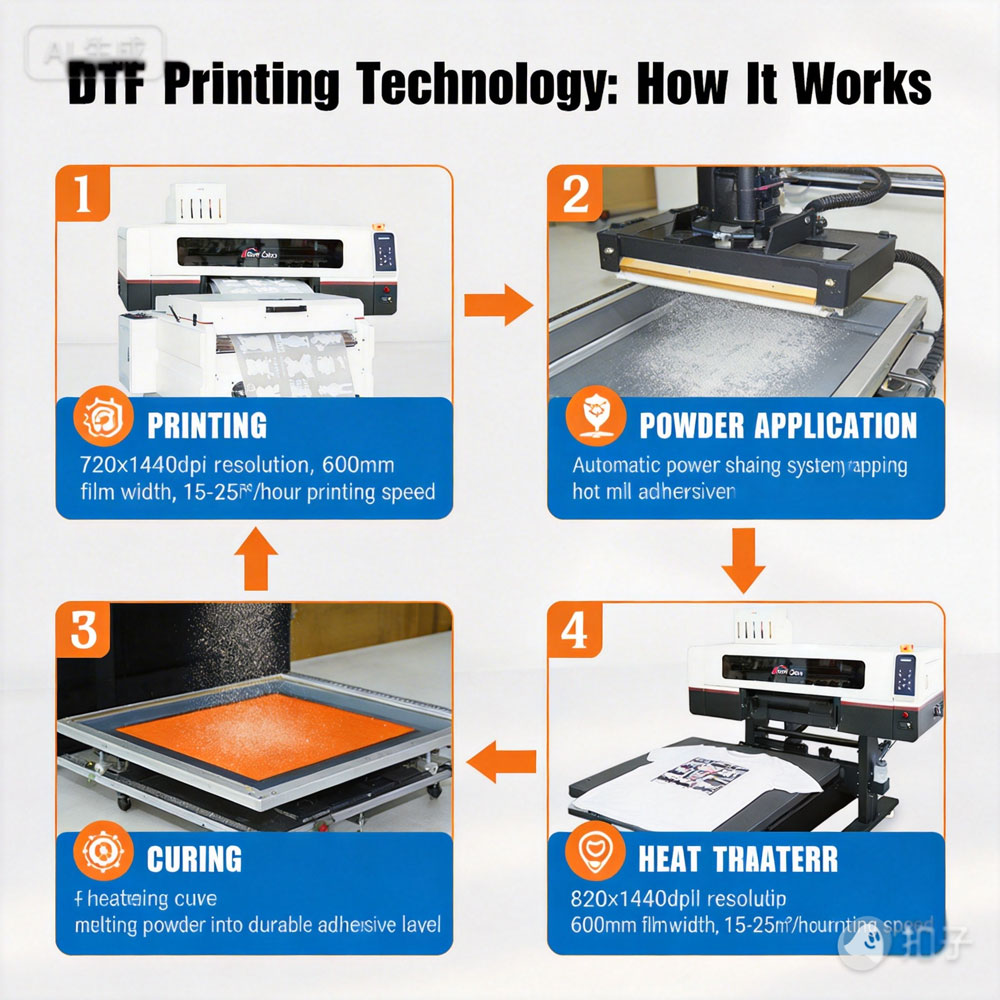
1. The Rise of a “Middle-Layer” Revolution
Direct-to-Film (DTF) printing is not just another textile technology—it represents a structural shift in how designs move from digital files to physical fabrics.
At its core, DTF introduces an intermediate layer—the transfer film—between design and fabric. This seemingly simple change solves one of the biggest historical limitations in textile printing: material dependency.
Industry data shows a clear trend:
- Growing demand for on-demand apparel and short-run production
- Rapid expansion of e-commerce customization models
- Increasing preference for multi-material compatibility
DTF sits exactly at the intersection of these needs.
2. What DTF Really Is (Beyond the Definition)
DTF (Direct-to-Film) is a process where designs are first printed onto a PET film, then transferred onto fabric using heat and adhesive powder.
But this definition is too shallow.
The real innovation is this:
DTF separates printing from application.
Unlike traditional methods:
- DTG → prints directly on fabric
- Screen printing → embeds ink through a stencil
- Sublimation → relies on material chemistry
DTF creates a portable, transferable design layer that can be applied anywhere, anytime.
3. The Process: A Controlled Chain of Material Transformation
DTF printing is a multi-stage system where each step defines final quality:
Step 1: Digital Printing on Film
Ink is printed onto a specialized PET transfer film, often with a white base layer for opacity.
Step 2: Adhesive Powder Application
A hot-melt powder (typically polyurethane) is applied, bonding to the wet ink and forming a transferable layer.
Step 3: Curing
The powder is melted to create a stable adhesive structure.
Step 4: Heat Transfer
Under 150–180°C, the design is pressed onto fabric, where ink and adhesive fuse with the material.
Step 5: Film Removal
The film is peeled away, leaving a durable, high-resolution print.
This is not just printing—it is layer engineering.
4. Why DTF Is Growing So Fast
DTF is expanding rapidly because it solves three long-standing industry bottlenecks:
1. Fabric Limitations
DTF works on cotton, polyester, blends, nylon, and more—including dark or textured fabrics.
2. Production Flexibility
No need for plates or setup. It supports:
- Single-piece customization
- Small batch orders
- Rapid prototyping
3. Cost Efficiency
Compared to screen printing, it eliminates plate-making costs and reduces waste.
The result:
DTF aligns perfectly with the economics of modern customization.
5. Quality: Where DTF Competes—and Wins
DTF delivers:
- High resolution (300–1200 DPI typical range)
- Strong color vibrancy and gradients
- Durable prints resistant to washing and friction
Compared to alternatives:
- Better than DTG on dark fabrics
- More flexible than sublimation
- More efficient than screen printing for small runs
However, there is a trade-off:
- Large-area prints may reduce fabric breathability
6. The Hidden Complexity No One Talks About
DTF is often marketed as “easy.” That’s misleading.
In practice, success depends on process control:
- Incorrect temperature → weak adhesion
- Poor powder curing → peeling issues
- Wrong pressure → damaged prints
Real-world operators consistently report that most failures come from process inconsistency, not technology limitations:
“Most issues come from… pressure, curing, or peeling timing.”
This reveals a deeper truth:
DTF is simple in theory, but precise in execution.
7. The Real Innovation: Decoupling Time and Production
One of the most underrated advantages of DTF:
You can produce transfers in advance and apply them later.
This enables:
- Inventory-based production of designs
- Distributed manufacturing models
- Faster fulfillment in e-commerce
In other words:
DTF separates production from fulfillment.
That is not a technical improvement—it is a business model shift.
8. Limitations That Define Its Future
Despite its strengths, DTF is not perfect:
- High initial equipment and consumable costs
- Multi-step workflow increases operational complexity
- Environmental concerns around inks and powders
However, trends indicate rapid improvement:
- Water-based inks
- Automated powder systems
- Multi-head high-speed printers
9. Breaking the Industry’s Old Logic
The traditional mindset:
“Printing happens where the fabric is.”
DTF breaks this completely.
Now:
- Printing happens on film
- Storage happens in inventory
- Application happens on demand
This creates a new paradigm:
Printing becomes modular.
10. Final Insight
DTF printing is not just a technique—it is a workflow revolution.
It transforms textile production from:
- Fixed → flexible
- Centralized → distributed
- Material-dependent → material-agnostic
The future of textile printing will not be defined by faster machines alone.
It will be defined by this idea:
Designs are no longer tied to fabrics—they are assets that can move, wait, and scale.
-
AuthorPosts
- You must be logged in to reply to this topic.