
Home › Forums › DTF Printer Hub › DTF Printing in the Clothing Industry: Applications, Advantages
- This topic is empty.
-
AuthorPosts
-
26 March 2026 at 7:22 pm #1026
Dowinsss
Keymaster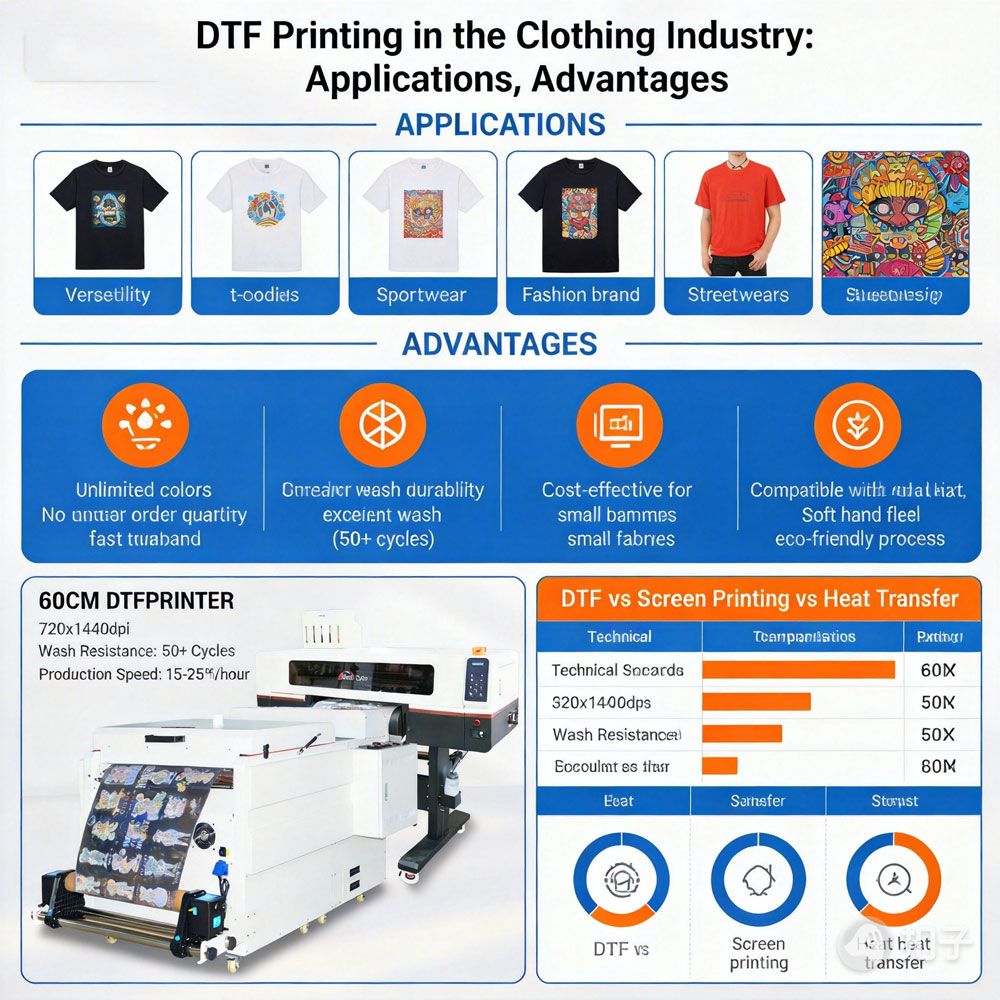
1. Clothing Is No Longer Mass Production—It’s Mass Customization
The clothing industry is undergoing a structural shift. Fast fashion is no longer driven solely by volume—it is driven by speed, personalization, and flexibility.
Key industry signals:
- Rising demand for custom apparel and small-batch production
- E-commerce pushing on-demand manufacturing models
- Shorter product cycles and higher SKU complexity
In this environment, traditional printing methods struggle. DTF (Direct-to-Film) printing emerges not as an alternative—but as a response to structural inefficiency.
2. Where DTF Fits in the Clothing Ecosystem
DTF printing has become deeply integrated across multiple apparel categories:
Everyday Apparel
T-shirts, hoodies, and casual wear remain the largest application segment. These garments, often made of cotton or blends, are highly compatible with DTF’s heat transfer process.
Sportswear and Performance Clothing
Durability is critical here. DTF prints offer strong resistance to washing and abrasion, making them suitable for high-use garments.
Workwear and Uniforms
Bulk customization with consistent quality is essential. DTF enables scalable production without sacrificing detail or durability.
Fashion and Streetwear
DTF enables complex graphics, gradients, and photo-quality designs—fueling the rise of independent brands and limited-edition collections.
Accessories and Extended Apparel
Beyond clothing, DTF is widely used for bags, hats, and textile accessories, expanding product lines without new production systems.
3. The Core Advantage: Material Freedom
Traditional printing methods are constrained:
- Sublimation → polyester only
- DTG → best on cotton
- Screen printing → setup-heavy
DTF breaks this limitation.
It can be applied to:
- Cotton
- Polyester
- Nylon
- Denim
- Blended fabrics
—even on dark or textured materials.
This is not just flexibility—it is market expansion.
4. Efficiency Redefined: From Bulk to On-Demand
DTF eliminates several legacy constraints:
- No plate making
- No minimum order quantity
- No complex setup
This enables:
- Single-piece customization
- Rapid design iteration
- Zero-inventory production models
Combined with e-commerce, this leads to a new production logic:
Sell first, produce later.
This significantly reduces inventory risk—one of the biggest inefficiencies in apparel manufacturing.
5. Quality That Competes Across Methods
DTF printing delivers:
- High-resolution graphics
- Strong color saturation
- Excellent wash durability (often reaching high color fastness levels)
Compared to other methods:
- More versatile than sublimation
- More flexible than screen printing for small runs
- More adaptable than DTG across materials
However, it is not flawless:
- Large-area prints may affect fabric breathability
- Improper processing can lead to a “film-like” texture
This reveals a key insight:
DTF quality is process-dependent, not just machine-dependent.
6. The Real Driver: Personalization Economy
Consumers are no longer passive buyers—they are co-creators.
DTF enables:
- Custom designs for individuals
- Micro-brand launches with low capital
- Personalized merchandise at scale
This aligns with broader trends:
- Creator economy
- Print-on-demand platforms
- Social commerce
As a result, DTF is not just a production tool—it is an enabler of new business models.
7. Breaking the Industry’s Old Logic
Traditional apparel manufacturing is built on:
- Forecasting demand
- Producing in bulk
- Managing inventory
DTF introduces a new paradigm:
- Produce based on real orders
- Minimize unsold stock
- Maximize design diversity
This is not optimization—it is a reversal of the supply chain logic.
8. The Future: From Printing to Distributed Manufacturing
DTF is pushing the clothing industry toward:
- Decentralized production networks
- Localized fulfillment centers
- Faster delivery cycles
Factories no longer need to be massive—they need to be flexible and digitally connected.
9. Final Insight
DTF printing is often described as a “technology upgrade.”
That is an underestimation.It is actually:
- A production model shift
- A supply chain transformation
- A response to consumer-driven manufacturing
The future of clothing will not be defined by who produces the most.
It will be defined by this:
Who can produce exactly what the customer wants—at the exact moment they want it.
-
AuthorPosts
- You must be logged in to reply to this topic.