
Home › Forums › DTF Printer Hub › Choosing the Right DTF Printer Manufacturer for Small T-Shirt Businesses
- This topic is empty.
-
AuthorPosts
-
12 March 2026 at 2:26 pm #981
Dowinsss
KeymasterThe custom apparel industry has experienced explosive growth in recent years. With the rise of e-commerce platforms, independent clothing brands, and on-demand manufacturing, small T-shirt businesses are emerging worldwide. Market analysts estimate that the global custom T-shirt printing market could exceed $10 billion within the next decade, driven by personalized fashion, influencer brands, and micro-entrepreneurship.
Within this ecosystem, DTF (Direct-to-Film) printing has rapidly become one of the most attractive technologies for startups. It allows entrepreneurs to produce vibrant, durable graphics on cotton, polyester, and blended fabrics without the complexity of traditional screen printing.
However, many new business owners face a critical question: How do you choose the right DTF printer manufacturer—especially when sourcing from China?
The answer goes far beyond comparing machine prices.
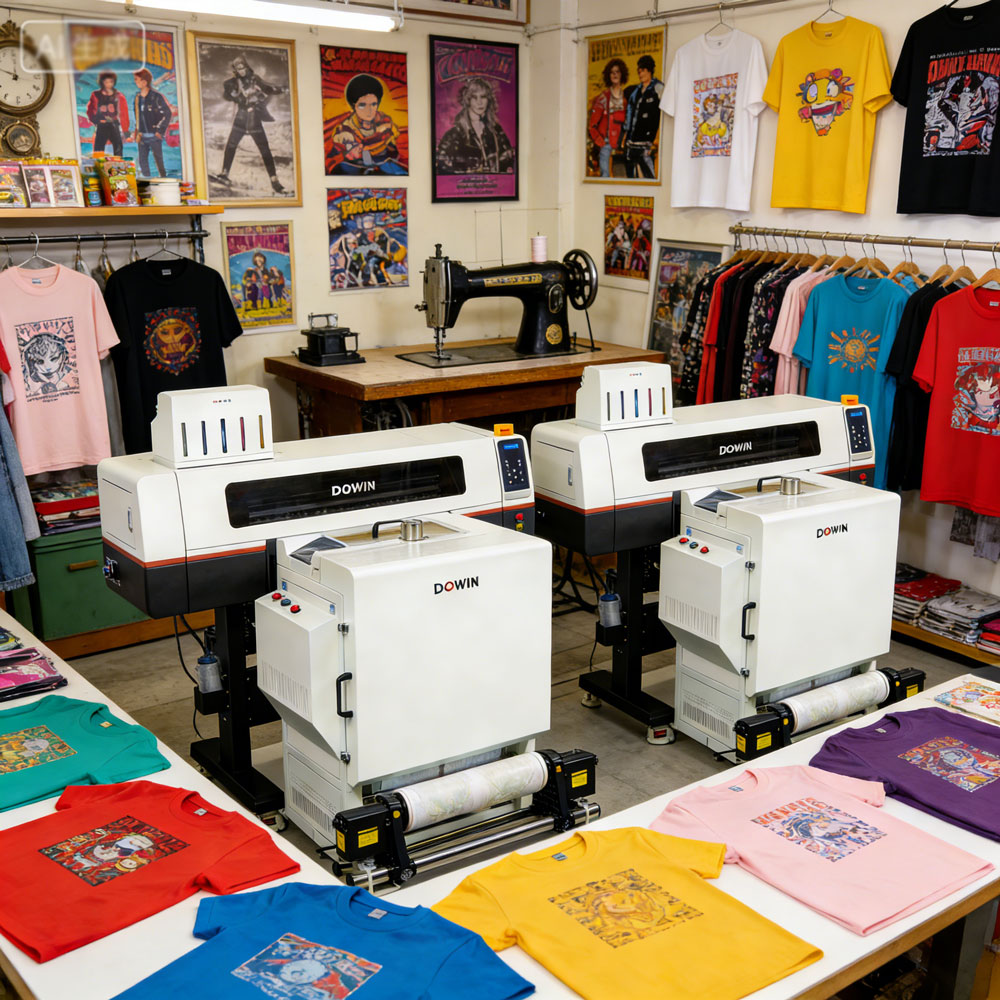
The Rise of DTF Printing in the Custom Apparel Economy
Traditional garment printing methods have clear limitations.
Screen printing requires large order volumes to be profitable.
Direct-to-garment printing works well but often struggles with darker fabrics and higher ink costs.DTF printing, by contrast, blends the advantages of digital printing and heat-transfer technology. Designs are printed onto PET film, coated with adhesive powder, cured, and then transferred to garments using a heat press.
This workflow enables several advantages for small businesses:
-
No minimum order quantity
-
Compatible with multiple fabric types
-
Vibrant colors and strong durability
-
Lower startup investment compared with industrial DTG systems
For entrepreneurs running Etsy stores, Shopify brands, or local print shops, DTF technology dramatically lowers the barrier to entry.
But buying the wrong printer can turn this opportunity into a costly mistake.
Why Manufacturer Selection Matters More Than the Machine
Many beginners focus only on hardware specifications. They compare printing speed, resolution, or the advertised production capacity.
In reality, the reliability of a DTF system depends more on the manufacturer ecosystem than the machine itself.
A printing system involves multiple components:
-
printheads
-
ink supply systems
-
white ink circulation
-
RIP software
-
heating and curing equipment
If these elements are poorly integrated, even a powerful machine will fail in real-world production.
Industry buyers therefore evaluate suppliers based on three key criteria: technical foundation, support infrastructure, and supply chain stability.
1. Printhead Technology: The Core of the System
The printhead is the most critical component in any DTF printer. Most machines on the market rely on industrial piezoelectric printheads originally developed for commercial inkjet platforms.
Different generations of printheads offer different levels of performance. Older models remain common because they are inexpensive and widely supported, while newer platforms offer higher resolution and faster firing frequency.
However, printhead hardware alone does not guarantee print quality.
What truly matters is whether the manufacturer has optimized:
-
firmware
-
ink formulation
-
color management profiles
Without proper calibration, even advanced printheads will struggle with common DTF problems such as white-ink sedimentation or inconsistent color output.
For small apparel businesses, stability is often more important than raw speed.
2. Software and Color Management
Many entrepreneurs underestimate the importance of RIP software.
DTF printing requires specialized software to interpret design files, control ink layering, and manage color output. This software determines how white ink is applied beneath colored layers and how gradients are reproduced on fabric.
Manufacturers with dedicated software development teams usually produce far more reliable systems because they maintain their own ICC color profiles and printing algorithms.
Without proper profiles, prints may appear dull, oversaturated, or inconsistent across different fabrics.
In other words, software is the invisible engine of DTF printing.
3. After-Sales Support: The Hidden Cost of Cheap Machines
One of the most overlooked factors when purchasing printing equipment is after-sales service.
A warranty means very little if replacement parts take weeks to arrive or technical support is unavailable. Industry experts recommend verifying whether the manufacturer maintains regional service partners or spare-parts warehouses before making a purchase.
In production environments, downtime directly translates into lost revenue.
Online discussions among print shop owners frequently emphasize that technical support can determine whether a machine becomes a productive asset—or an expensive piece of idle equipment.
“Saving a little money upfront is not worth it if your DTF printer is sitting there not working.”
For small businesses with tight margins, responsive support can be more valuable than any hardware upgrade.
4. Scalability for Growing Apparel Brands
Many small T-shirt businesses start with modest production volumes—perhaps printing a few dozen garments per day.
But successful brands often scale rapidly once designs gain popularity online.
When selecting a manufacturer, entrepreneurs should consider whether the supplier offers a full equipment ecosystem, including:
-
larger film printers
-
automated powder shakers
-
curing ovens
-
higher-speed industrial systems
Choosing a manufacturer with an upgrade path allows businesses to expand production without replacing their entire workflow.
A Different Way to Think About DTF Equipment
The biggest misconception in the startup apparel industry is believing that a printer alone will build a successful business.
In reality, DTF printing is only a tool.
The real competitive advantage comes from:
-
strong brand identity
-
unique graphic design
-
efficient order fulfillment
-
smart online marketing
Many entrepreneurs become obsessed with hardware comparisons while ignoring the larger business strategy.
Ironically, some of the most successful clothing brands operate with relatively simple printing setups—but dominate their niche through design creativity and community engagement.
Technology enables production.
Creativity drives demand.Conclusion
DTF printing has reshaped the custom apparel industry, empowering small businesses to produce professional-quality garments with relatively low investment.
However, choosing the right manufacturer requires careful evaluation of more than just price or specifications.
Entrepreneurs should focus on:
-
printhead stability and ink compatibility
-
software and color management systems
-
reliable technical support
-
long-term scalability
In the era of digital manufacturing, the best equipment is not necessarily the most expensive—it is the one supported by a complete technical ecosystem.
For small T-shirt businesses aiming to compete in the global customization economy, selecting the right printing partner may be the most important decision they make.
-
-
AuthorPosts
- You must be logged in to reply to this topic.